Question 10
A dimensionless family of repeated-root responses satisfies The design requirement is for every , with the additional constraint .
Tasks
Solve the IVP and prove that the response is positive and strictly decreasing for .
Show that the first time at level is , where is the unique root of . Locate between two consecutive four-decimal-place numbers by a justified numerical calculation.
Translate both the settling requirement and the initial-acceleration constraint into restrictions on . Determine whether they can be satisfied simultaneously.
Find the earliest achievable settling time under the acceleration constraint alone. Sketch the responses for with the tolerance and required time marked, and explain why simply increasing is not an admissible unlimited improvement.
Show solutionHide solution
Question 10 – Solution
Strategy. Scale time by the repeated decay rate, then compare the performance requirement with the independent constraint on the initial acceleration.
Step 1: Solve and establish monotonicity. The repeated root is . The data give The response is positive, strictly decreasing for , starts at 1 and tends to zero. Therefore crossing the tolerance once is enough to guarantee it thereafter.
Step 2: Reduce the crossing calculation to one dimensionless number. Let for . Then , and for . The intermediate value theorem and strict decrease give exactly one positive root .
Direct evaluation gives and . Thus Numerically ; the bracket, rather than a rounded equality, supports the feasibility comparisons below.
Step 3: Test simultaneous feasibility. Settling by time 2 requires , or . But the equation at zero gives , so the acceleration constraint requires . These ranges do not intersect: .
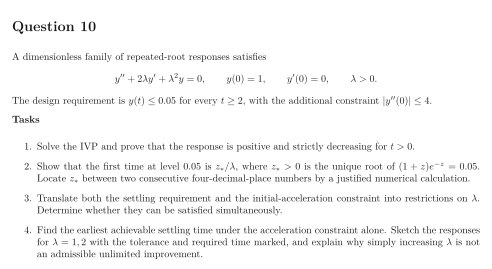
At the largest admissible value , the response at the deadline is , confirming the failure directly.
See the diagram in the original worksheet below.
Step 4: Optimize within the allowed family. The settling time strictly decreases as increases. Under , it is minimized at , giving This is later than the required time 2. Larger would improve the settling time but violate the initial-acceleration bound. The conclusion optimizes this explicitly specified family and constraint, not every possible differential-equation model or control law.