Question 8
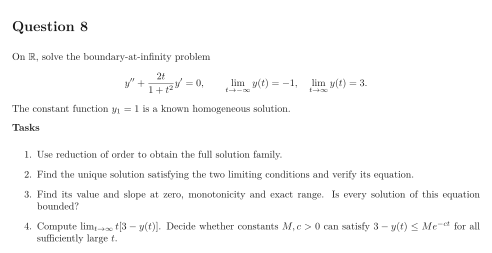
On , solve the boundary-at-infinity problem The constant function is a known homogeneous solution.
Tasks
Use reduction of order to obtain the full solution family.
Find the unique solution satisfying the two limiting conditions and verify its equation.
Find its value and slope at zero, monotonicity and exact range. Is every solution of this equation bounded?
Compute . Decide whether constants can satisfy for all sufficiently large .
Show solutionHide solution
Question 8 – Solution
Strategy. A constant seed reduces the equation directly to a first-order equation for the slope.
Step 1: Integrate the slope. Set . An integrating factor is , so
Step 2: Fit the two limits. The equations and give This is the unique choice of the two constants. Its derivatives and cancel in the original equation.
Step 3: Describe the trajectory. The value and slope at zero are and . The slope is positive everywhere; continuity and the limiting values give range . Every member is bounded, since .
Step 4: Determine the tail rate. For , Here as . An exponential bound would force this positive limit to be at most , a contradiction. The approach to the limit has an algebraic tail.
See the diagram in the original worksheet below.
