Question 10
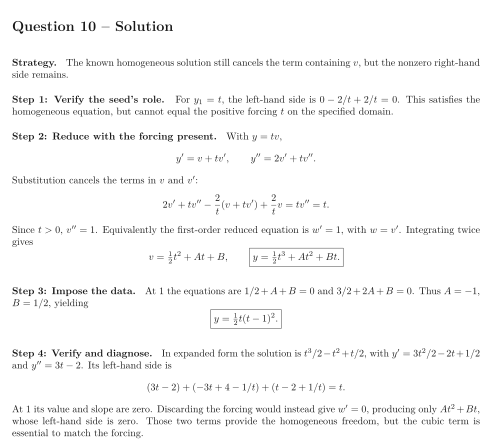
On , consider the forced equation The function is supplied as a solution of the associated homogeneous equation.
Tasks
Verify the stated role of and explain why it is not a solution of the forced equation.
Substitute and derive a reduced equation. Find the full forced solution family, retaining both integration constants.
Solve the given initial-value problem.
Check the original residual and data directly. Explain the error in applying the homogeneous reduction formula without carrying along the forcing term.
Show solutionHide solution
Question 10 – Solution
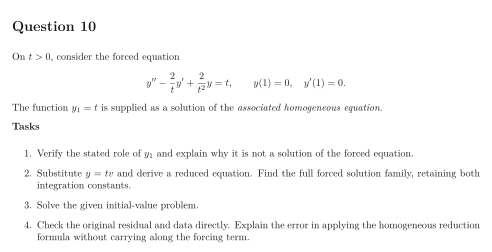
Strategy. The known homogeneous solution still cancels the term containing , but the nonzero right-hand side remains.
Step 1: Verify the seed’s role. For , the left-hand side is . This satisfies the homogeneous equation, but cannot equal the positive forcing on the specified domain.
Step 2: Reduce with the forcing present. With , Substitution cancels the terms in and : Since , . Equivalently the first-order reduced equation is , with . Integrating twice gives
Step 3: Impose the data. At the equations are and . Thus , , yielding
Step 4: Verify and diagnose. In expanded form the solution is , with and . Its left-hand side is At its value and slope are zero. Discarding the forcing would instead give , producing only , whose left-hand side is zero. Those two terms provide the homogeneous freedom, but the cubic term is essential to match the forcing.