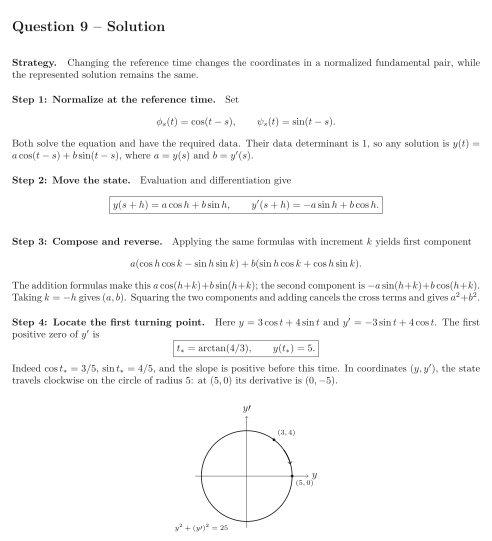
Question 9
For on , let the state at a time mean the ordered pair . Fix a real reference time .
Tasks
Construct a fundamental pair with state data and at time . Express any solution in that pair.
Derive explicit formulas for the state at in terms of the state at .
Show that moving the reference time by and then gives the same result as moving it by , and that the move by reverses the move by . Prove that is preserved.
For initial state at zero, find the first positive time when the slope is zero and the value then. Describe the direction of travel in the state plane.
Show solutionHide solution
Question 9 – Solution
Strategy. Changing the reference time changes the coordinates in a normalized fundamental pair, while the represented solution remains the same.
Step 1: Normalize at the reference time. Set Both solve the equation and have the required data. Their data determinant is , so any solution is , where and .
Step 2: Move the state. Evaluation and differentiation give
Step 3: Compose and reverse. Applying the same formulas with increment yields first component The addition formulas make this ; the second component is . Taking gives . Squaring the two components and adding cancels the cross terms and gives .
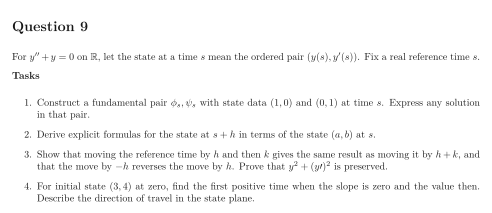
Step 4: Locate the first turning point. Here and . The first positive zero of is Indeed , , and the slope is positive before this time. In coordinates , the state travels clockwise on the circle of radius : at its derivative is .
See the diagram in the original worksheet below.