Question 1
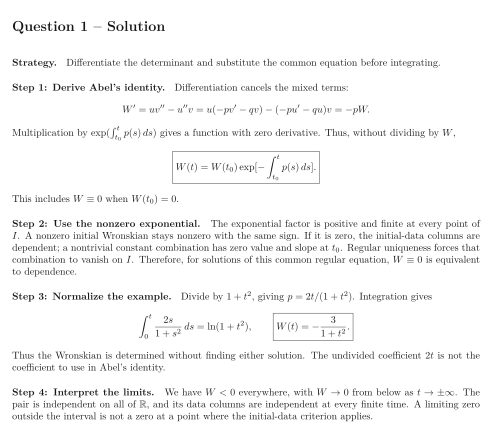
For two real solutions of on a connected open interval , define the ordered Wronskian Assume are continuous and .
Tasks
Derive a first-order equation for and solve it in terms of . Your derivation must include the case .
Prove that either vanishes everywhere on or never vanishes there. Explain the consequences for independence of the two solutions.
For on , find if , without solving the second-order equation.
Find the sign and limiting values of this Wronskian. Does its approach to zero at infinity imply that the solutions become dependent at a finite time?
Show solutionHide solution
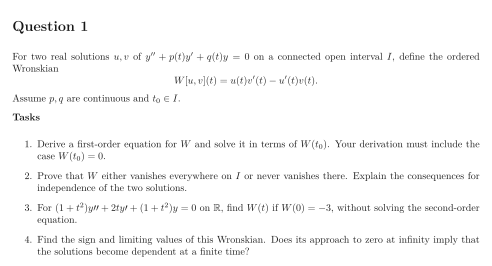
Question 1 – Solution
Strategy. Differentiate the determinant and substitute the common equation before integrating.
Step 1: Derive Abel’s identity. Differentiation cancels the mixed terms: Multiplication by gives a function with zero derivative. Thus, without dividing by , This includes when .
Step 2: Use the nonzero exponential. The exponential factor is positive and finite at every point of . A nonzero initial Wronskian stays nonzero with the same sign. If it is zero, the initial-data columns are dependent; a nontrivial constant combination has zero value and slope at . Regular uniqueness forces that combination to vanish on . Therefore, for solutions of this common regular equation, is equivalent to dependence.
Step 3: Normalize the example. Divide by , giving . Integration gives Thus the Wronskian is determined without finding either solution. The undivided coefficient is not the coefficient to use in Abel’s identity.
Step 4: Interpret the limits. We have everywhere, with from below as . The pair is independent on all of , and its data columns are independent at every finite time. A limiting zero outside the interval is not a zero at a point where the initial-data criterion applies.