Question 2
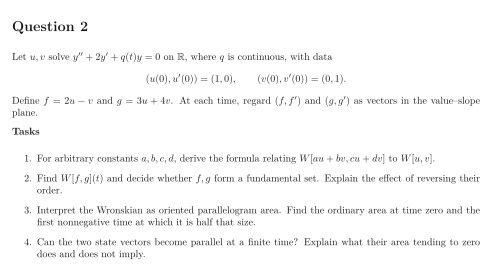
Let solve on , where is continuous, with data Define and . At each time, regard and as vectors in the value–slope plane.
Tasks
For arbitrary constants , derive the formula relating to .
Find and decide whether form a fundamental set. Explain the effect of reversing their order.
Interpret the Wronskian as oriented parallelogram area. Find the ordinary area at time zero and the first nonnegative time at which it is half that size.
Can the two state vectors become parallel at a finite time? Explain what their area tending to zero does and does not imply.
Show solutionHide solution
Question 2 – Solution
Strategy. Separate the constant determinant of a basis change from the time evolution supplied by Abel’s identity.
Step 1: Expand the determinant. Terms containing or cancel, leaving The constants may be factored through differentiation; this step would require extra terms for time-dependent coefficients.
Step 2: Apply the two determinants. Here and , so . The coefficient determinant is , hence Both combinations solve the equation and are independent, so they are fundamental. Reversing their order negates the Wronskian but leaves independence unchanged.
Step 3: Compute the area. The columns , have signed area and ordinary area . At zero they are and , with area . The half-area equation gives The area is strictly decreasing for , so this is the first such time.
Step 4: Distinguish collapse from a limit. The determinant never vanishes at finite , so the two state vectors never become parallel there. The area tends to zero as ; this does not destroy finite-time independence. Area alone also does not specify the lengths of the two vectors or their angle separately.
See the diagram in the original worksheet below.
