Question 5
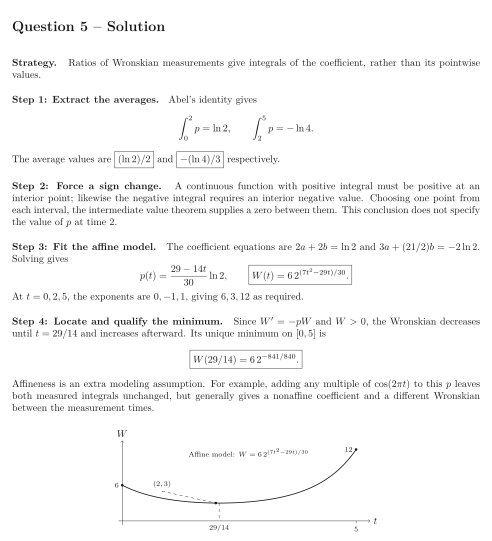
Two independent solutions of a regular equation on have measured ordered Wronskians Assume are continuous and the measurements are exact.
Tasks
Find and , and the average value of on each interval.
Prove that is positive somewhere in , negative somewhere in , and zero somewhere in .
Under the additional assumption that , determine and the full Wronskian function. Check all three measurements.
For this affine model, find the unique minimum of on . Explain why three Wronskian samples alone do not prove that the true coefficient is affine.
Show solutionHide solution
Question 5 – Solution
Strategy. Ratios of Wronskian measurements give integrals of the coefficient, rather than its pointwise values.
Step 1: Extract the averages. Abel’s identity gives The average values are and respectively.
Step 2: Force a sign change. A continuous function with positive integral must be positive at an interior point; likewise the negative integral requires an interior negative value. Choosing one point from each interval, the intermediate value theorem supplies a zero between them. This conclusion does not specify the value of at time .
Step 3: Fit the affine model. The coefficient equations are and . Solving gives At , the exponents are , giving as required.
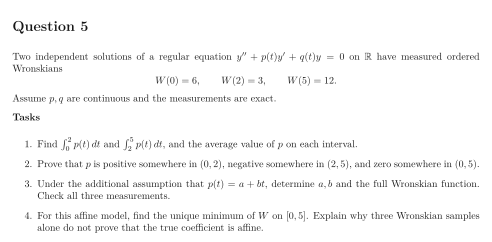
Step 4: Locate and qualify the minimum. Since and , the Wronskian decreases until and increases afterward. Its unique minimum on is Affineness is an extra modeling assumption. For example, adding any multiple of to this leaves both measured integrals unchanged, but generally gives a nonaffine coefficient and a different Wronskian between the measurement times.
See the diagram in the original worksheet below.