Question 7
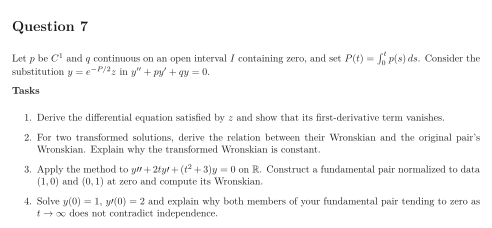
Let be and continuous on an open interval containing zero, and set . Consider the substitution in .
Tasks
Derive the differential equation satisfied by and show that its first-derivative term vanishes.
For two transformed solutions, derive the relation between their Wronskian and the original pair’s Wronskian. Explain why the transformed Wronskian is constant.
Apply the method to on . Construct a fundamental pair normalized to data and at zero and compute its Wronskian.
Solve , and explain why both members of your fundamental pair tending to zero as does not contradict independence.
Show solutionHide solution
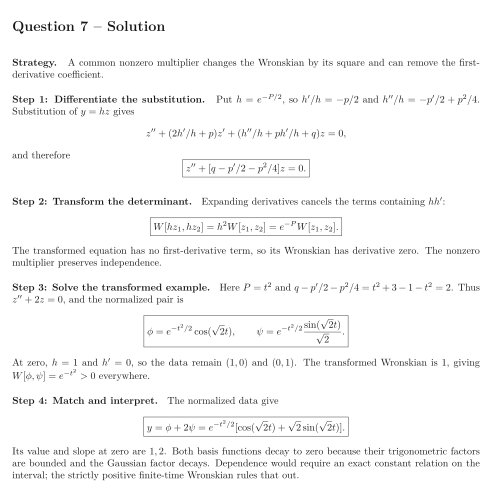
Question 7 – Solution
Strategy. A common nonzero multiplier changes the Wronskian by its square and can remove the first-derivative coefficient.
Step 1: Differentiate the substitution. Put , so and . Substitution of gives and therefore
Step 2: Transform the determinant. Expanding derivatives cancels the terms containing : The transformed equation has no first-derivative term, so its Wronskian has derivative zero. The nonzero multiplier preserves independence.
Step 3: Solve the transformed example. Here and . Thus , and the normalized pair is At zero, and , so the data remain and . The transformed Wronskian is , giving everywhere.
Step 4: Match and interpret. The normalized data give Its value and slope at zero are . Both basis functions decay to zero because their trigonometric factors are bounded and the Gaussian factor decays. Dependence would require an exact constant relation on the interval; the strictly positive finite-time Wronskian rules that out.