Question 9
On , consider the original undivided equation and the smooth candidates , . A classical global solution here means a function on satisfying this undivided equation at every point.
Tasks
Verify both candidates and compute their Wronskian. Determine their independence on and identify every zero of the Wronskian.
Apply Abel’s identity separately on the two largest regular intervals. Explain why its zero-or-never-zero conclusion cannot be applied across zero.
Find every classical global solution by matching the general solutions from the negative and positive sides through zero.
Find all global solutions with , . Explain both the failure of uniqueness and why no regular normalized equation through zero can have this candidate pair as solutions.
Show solutionHide solution
Question 9 – Solution
Strategy. The singular leading coefficient changes which interval hypotheses are available; explicitly match derivatives to determine global solutions.
Step 1: Verify and compute. The residuals are and . Also It is zero only at . The functions are independent on , since forces .
Step 2: Respect the regular intervals. Division by gives , , continuous on and . On either interval Abel’s identity gives , with the constant fixed within that interval. For this pair it is on both sides. There is no regular interval containing zero. Abel’s conclusion applies separately on the two intervals and makes no assertion across zero.
Step 3: Match all global solutions. The pair is fundamental on either side, so write for and for . Continuity forces . Matching first derivatives forces ; matching second derivatives forces . Conversely every resulting polynomial solves the equation globally. Thus
Step 4: Inspect the singular data. The data give but leave arbitrary, so all solutions are . Uniqueness fails despite this two-dimensional global family. No regular normalized equation through zero could include : at zero its value and slope vanish while its second derivative is , making the normalized equation impossible there.
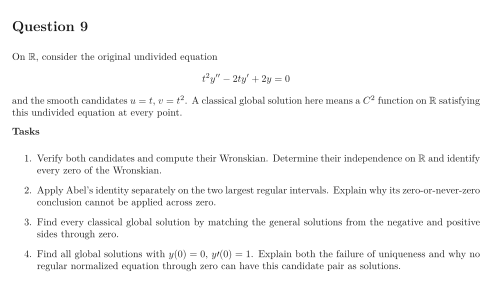
See the diagram in the original worksheet below.