Question 10
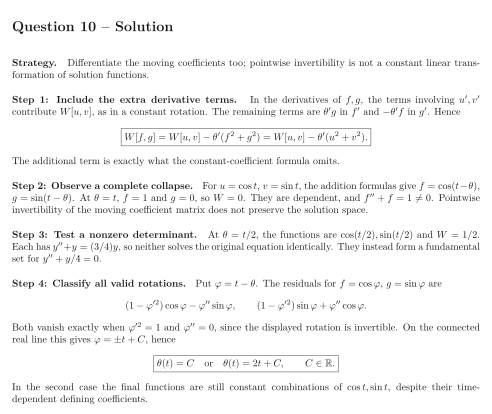
Let be real functions on an interval and let be a real function. Define time-dependent combinations At every time the two-by-two coefficient matrix has determinant .
Tasks
Derive the actual expression for in terms of and their derivatives. Explain why the constant change-of-basis formula cannot simply be used.
Take , , on . Compute and their Wronskian. Does the pointwise invertibility preserve a fundamental set for ?
Keep the same but take . Show that a nonzero resulting Wronskian still does not make the new pair solutions of the original equation.
For these trigonometric , classify every real function on for which both solve .
Show solutionHide solution
Question 10 – Solution
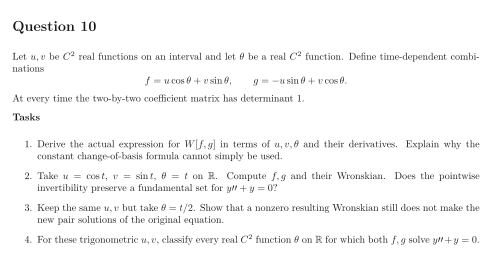
Strategy. Differentiate the moving coefficients too; pointwise invertibility is not a constant linear transformation of solution functions.
Step 1: Include the extra derivative terms. In the derivatives of , the terms involving contribute , as in a constant rotation. The remaining terms are in and in . Hence The additional term is exactly what the constant-coefficient formula omits.
Step 2: Observe a complete collapse. For , , the addition formulas give , . At , and , so . They are dependent, and . Pointwise invertibility of the moving coefficient matrix does not preserve the solution space.
Step 3: Test a nonzero determinant. At , the functions are and . Each has , so neither solves the original equation identically. They instead form a fundamental set for .
Step 4: Classify all valid rotations. Put . The residuals for , are Both vanish exactly when and , since the displayed rotation is invertible. On the connected real line this gives , hence In the second case the final functions are still constant combinations of , despite their time-dependent defining coefficients.