Question 2
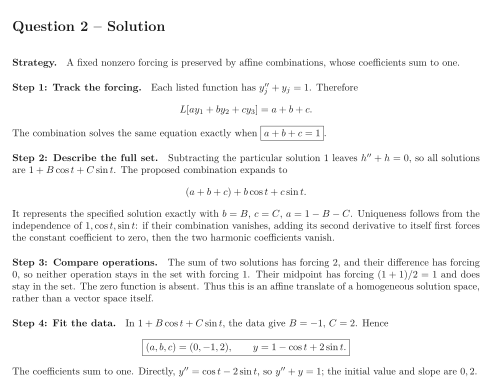
For on , define Consider constant combinations , where .
Tasks
Verify all three solutions and find the necessary and sufficient condition on for their combination to solve the same forced equation.
Prove that every solution of has exactly one representation satisfying that condition.
Explain whether the solution set is closed under sums, differences and midpoints. Identify the equation satisfied by the difference of two forced solutions.
Find the unique coefficients producing , , and verify the resulting solution.
Show solutionHide solution
Question 2 – Solution
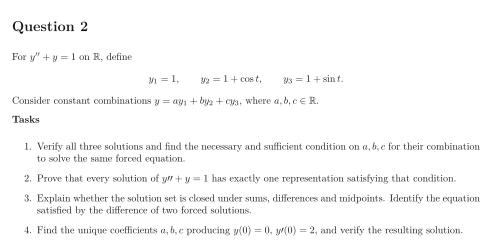
Strategy. A fixed nonzero forcing is preserved by affine combinations, whose coefficients sum to one.
Step 1: Track the forcing. Each listed function has . Therefore The combination solves the same equation exactly when .
Step 2: Describe the full set. Subtracting the particular solution leaves , so all solutions are . The proposed combination expands to It represents the specified solution exactly with , , . Uniqueness follows from the independence of : if their combination vanishes, adding its second derivative to itself first forces the constant coefficient to zero, then the two harmonic coefficients vanish.
Step 3: Compare operations. The sum of two solutions has forcing , and their difference has forcing , so neither operation stays in the set with forcing . Their midpoint has forcing and does stay in the set. The zero function is absent. Thus this is an affine translate of a homogeneous solution space, rather than a vector space itself.
Step 4: Fit the data. In , the data give , . Hence The coefficients sum to one. Directly, , so ; the initial value and slope are .