Question 3
Consider on , with . A proposed trial includes only the cosine term .
Tasks
Explain why a polynomial sine component must also be included, and write the smallest complete trigonometric-polynomial trial.
Determine its coefficients by matching both sine and cosine terms.
Solve the zero-data initial-value problem and verify the data.
Explain why nonresonance with frequency does not guarantee a bounded response to this forcing. Prove that the selected response is unbounded on .
Show solutionHide solution
Question 3 – Solution
Strategy. Polynomial differentiation couples the sine and cosine components even when only one appears in the forcing.
Step 1: Complete the trial space. Use Frequency differs from the homogeneous frequency , so no extra power of is needed for resonance. Nevertheless, differentiating the proposed cosine-only term twice produces , which cannot be ignored.
Step 2: Match all terms. Applying to the complete trial gives Thus , , , , and
Step 3: Fit the initial state. The particular data are and . The homogeneous correction is therefore , giving Its value and slope at zero vanish, and the correction leaves the verified forcing unchanged.
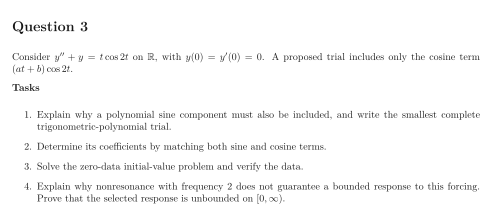
Step 4: Separate resonance from forcing growth. The forcing itself has a factor and is unbounded. At , the solution is . At , it is . Thus it is unbounded in both directions despite the absence of frequency resonance. Nonresonance alone is not a boundedness guarantee when the forcing amplitude grows.
See the diagram in the original worksheet below.