Question 5
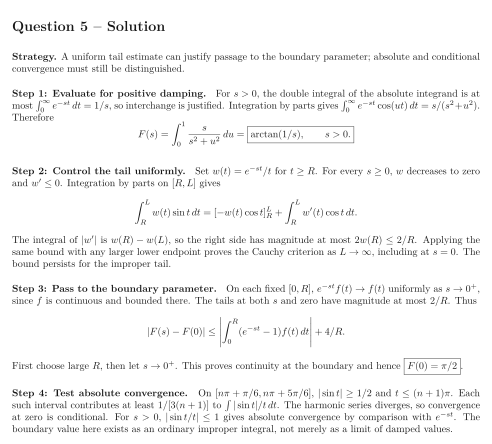
For real , use whenever this ordinary improper integral converges.
Let for , with . In this problem examine parameters . You may derive the positive-parameter transform using .
Tasks
For , justify interchanging the two integrations and evaluate .
For and , prove the tail bound , including existence of the tail at .
Use that uniform tail bound and finite-interval convergence as to determine .
Determine whether the integral at converges absolutely, and contrast it with the positive-parameter integrals.
Show solutionHide solution
Question 5 – Solution
Strategy. A uniform tail estimate can justify passage to the boundary parameter; absolute and conditional convergence must still be distinguished.
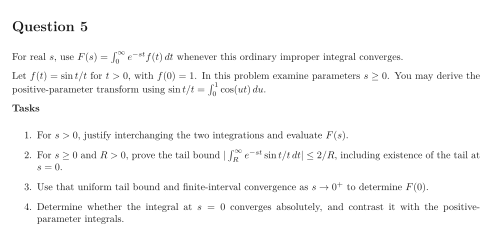
Step 1: Evaluate for positive damping. For , the double integral of the absolute integrand is at most , so interchange is justified. Integration by parts gives . Therefore
Step 2: Control the tail uniformly. Set for . For every , decreases to zero and . Integration by parts on gives The integral of is , so the right side has magnitude at most . Applying the same bound with any larger lower endpoint proves the Cauchy criterion as , including at . The bound persists for the improper tail.
Step 3: Pass to the boundary parameter. On each fixed , uniformly as , since is continuous and bounded there. The tails at both and zero have magnitude at most . Thus First choose large , then let . This proves continuity at the boundary and hence .
Step 4: Test absolute convergence. On , and . Each such interval contributes at least to . The harmonic series diverges, so convergence at zero is conditional. For , gives absolute convergence by comparison with . The boundary value here exists as an ordinary improper integral, not merely as a limit of damped values.