Question 8
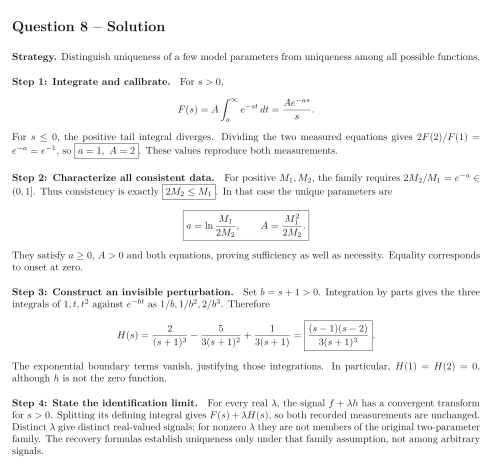
For real , use whenever this ordinary improper integral converges.
An unknown signal belongs to the family for and for , where and . Exact measurements are
Tasks
Derive the transform and its real convergence set directly, then recover and from the measurements.
For arbitrary positive measurements and , give a necessary and sufficient consistency condition for this family and explicit recovery formulas.
For , compute its transform at directly by integration by parts and show that it vanishes at both measured parameters.
Use to explain precisely why the two measurements identify the signal within the stated family but do not identify an arbitrary real-valued signal.
Show solutionHide solution
Question 8 – Solution
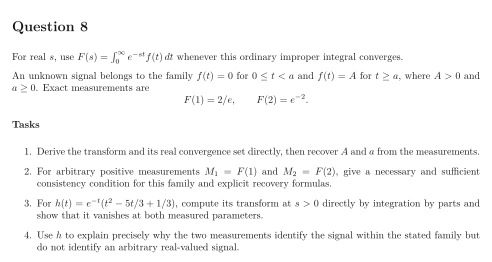
Strategy. Distinguish uniqueness of a few model parameters from uniqueness among all possible functions.
Step 1: Integrate and calibrate. For , For , the positive tail integral diverges. Dividing the two measured equations gives , so . These values reproduce both measurements.
Step 2: Characterize all consistent data. For positive , the family requires . Thus consistency is exactly . In that case the unique parameters are They satisfy , and both equations, proving sufficiency as well as necessity. Equality corresponds to onset at zero.
Step 3: Construct an invisible perturbation. Set . Integration by parts gives the three integrals of against as . Therefore The exponential boundary terms vanish, justifying those integrations. In particular, , although is not the zero function.
Step 4: State the identification limit. For every real , the signal has a convergent transform for . Splitting its defining integral gives , so both recorded measurements are unchanged. Distinct give distinct real-valued signals; for nonzero they are not members of the original two-parameter family. The recovery formulas establish uniqueness only under that family assumption, not among arbitrary signals.