Question 10
For real , use whenever this ordinary improper integral converges.
A continuous signal on satisfies , and its observed part is on . Its future after one is unknown. Consider .
Tasks
Derive explicit lower and upper bounds for using only this information.
Decide which bound is attained within the continuous signal class. Construct admissible signals approaching any unattained bound.
State the exact resulting range of possible values of , justifying that every value in that range is possible.
Find the width of the uncertainty interval for general , prove it decreases with , and find the smallest positive integer making the width at most .
Show solutionHide solution
Question 10 – Solution
Strategy. Positivity of the Laplace weight gives bounds; continuity at the last observed point decides whether an extremum is actually attained.
Step 1: Bound the unknown tail. The observed contribution is The remaining integral lies between zero and . Therefore All integrals converge absolutely because and .
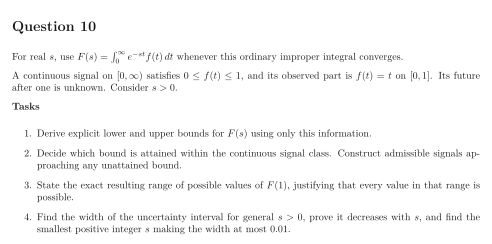
Step 2: Resolve attainment. The upper bound is attained by . The lower bound is not attained: continuity and force a strictly positive contribution on some interval immediately after one. For , instead continue linearly from to and then stay zero. This continuous satisfies Thus is the infimum, while is a maximum.
Step 3: Give the full range at one. Substitution gives the interval For any target strictly above the lower endpoint, choose small enough that is below it. A convex combination of and the upper-bound signal remains continuous, in , and agrees with the observed ramp. Splitting the defining integral shows its transform is the same convex combination. Choosing the weight appropriately reaches the target, proving no intermediate values are missing.
Step 4: Measure the uncertainty. The interval width is , with Since and , the least positive integer meeting the tolerance is . Increasing reduces sensitivity to the unknown late-time portion; it does not supply missing pointwise information about that future.
See the diagram in the original worksheet below.