Question 10
Use causal one-sided Laplace transforms. Write for and for . Ordinary functions are zero for . Justify the table entries and operational rules you use; give exact expressions.
Use the chapter’s table and operational rules to solve Ordinary force impulses preserve displacement and may jump velocity. All figures belong on the solution page.
Tasks
Find , carefully retaining both initial terms and the two different forcing operations.
Invert the transform and give the response on the three intervals separated by and .
Verify the initial state, the equation between switches, and the one-sided displacement and velocity changes at each switch.
Compute the total response area in two ways and determine the exact real transform domain. Explain why this finite list of table operations gives a unique solution.
Show solutionHide solution
Question 10 – Solution
Strategy. Separate the initial response, delayed ordinary forcing and impulse response before inversion.
Step 1: Transform with all data. The left side transforms to . Consequently The ordinary forcing has transform ; the impulse has transform .
Step 2: Invert and make the intervals explicit. Define and for . The factorial in the fourth-power table row gives
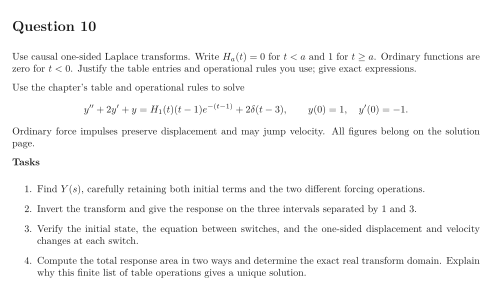
Step 3: Verify each kind of activation. The initial branch gives . For and any polynomial , . Thus produces and produces zero between switches. At , , so displacement and velocity remain continuous. At , , , so and . Here . These are exactly the required jump conditions.
Step 4: Check area, convergence and uniqueness. Direct areas are , , and , giving . Independently, integrating the equation, including the velocity jump, gives , again yielding . The tail is a nonzero cubic polynomial times , so the exact real domain is . Linear IVP uniqueness on each ordinary interval, together with the forced matching and jump conditions, fixes the whole solution.
See the diagram in the original worksheet below.