Question 1
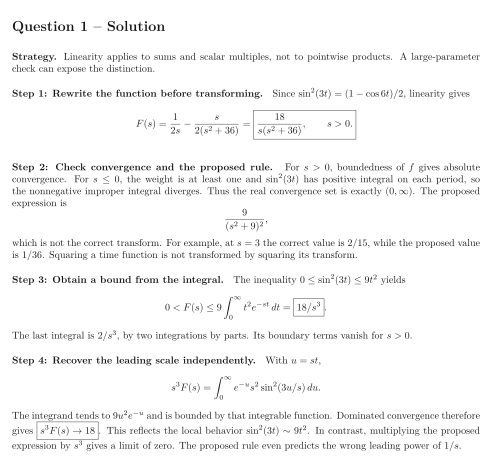
For real , write where the integral converges.
Let . A student proposes You may use , and for .
Tasks
Find the correct transform using a trigonometric identity and linearity.
Determine the full real convergence set and compare the correct result with the student’s proposed expression.
Use to prove a direct upper bound for the transform when .
Use in the defining integral to derive independently of the rational formula. Explain how this limit diagnoses the proposed product rule.
Show solutionHide solution
Question 1 – Solution
Strategy. Linearity applies to sums and scalar multiples, not to pointwise products. A large-parameter check can expose the distinction.
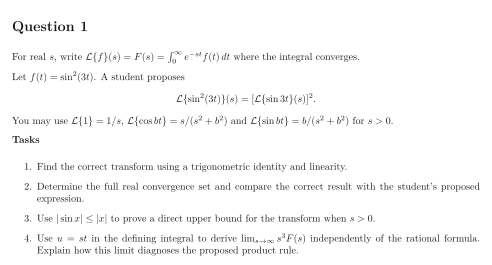
Step 1: Rewrite the function before transforming. Since , linearity gives
Step 2: Check convergence and the proposed rule. For , boundedness of gives absolute convergence. For , the weight is at least one and has positive integral on each period, so the nonnegative improper integral diverges. Thus the real convergence set is exactly . The proposed expression is which is not the correct transform. For example, at the correct value is , while the proposed value is . Squaring a time function is not transformed by squaring its transform.
Step 3: Obtain a bound from the integral. The inequality yields The last integral is , by two integrations by parts. Its boundary terms vanish for .
Step 4: Recover the leading scale independently. With , The integrand tends to and is bounded by that integrable function. Dominated convergence therefore gives . This reflects the local behavior . In contrast, multiplying the proposed expression by gives a limit of zero. The proposed rule even predicts the wrong leading power of .