Question 3
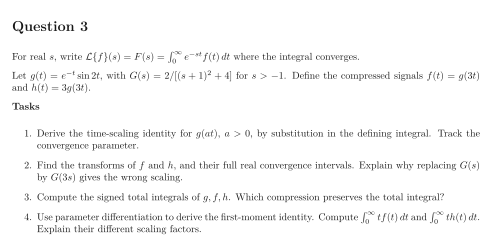
For real , write where the integral converges.
Let , with for . Define the compressed signals and .
Tasks
Derive the time-scaling identity for , , by substitution in the defining integral. Track the convergence parameter.
Find the transforms of and , and their full real convergence intervals. Explain why replacing by gives the wrong scaling.
Compute the signed total integrals of . Which compression preserves the total integral?
Use parameter differentiation to derive the first-moment identity. Compute and . Explain their different scaling factors.
Show solutionHide solution
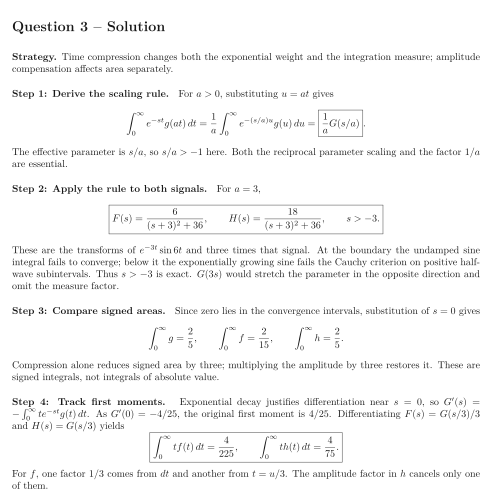
Question 3 – Solution
Strategy. Time compression changes both the exponential weight and the integration measure; amplitude compensation affects area separately.
Step 1: Derive the scaling rule. For , substituting gives The effective parameter is , so here. Both the reciprocal parameter scaling and the factor are essential.
Step 2: Apply the rule to both signals. For , These are the transforms of and three times that signal. At the boundary the undamped sine integral fails to converge; below it the exponentially growing sine fails the Cauchy criterion on positive half-wave subintervals. Thus is exact. would stretch the parameter in the opposite direction and omit the measure factor.
Step 3: Compare signed areas. Since zero lies in the convergence intervals, substitution of gives Compression alone reduces signed area by three; multiplying the amplitude by three restores it. These are signed integrals, not integrals of absolute value.
Step 4: Track first moments. Exponential decay justifies differentiation near , so . As , the original first moment is . Differentiating and yields For , one factor comes from and another from . The amplitude factor in cancels only one of them.