Question 5
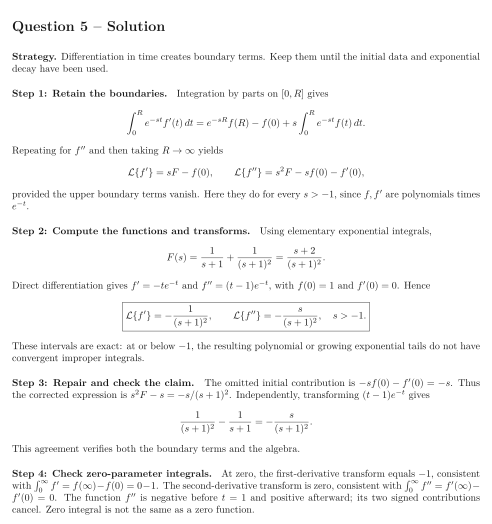
For real , write where the integral converges.
Let . A student claims that the second derivative has transform , without any initial terms.
Tasks
Derive the first- and second-derivative transform formulas using integration by parts on a finite interval before taking the limit.
Compute , and , and obtain their transforms explicitly.
Identify the omitted term in the student’s claim and verify the corrected result independently from the expression for .
Evaluate the transforms of and at and check them using endpoint differences. Explain how a nonzero second derivative can have zero total signed integral.
Show solutionHide solution
Question 5 – Solution
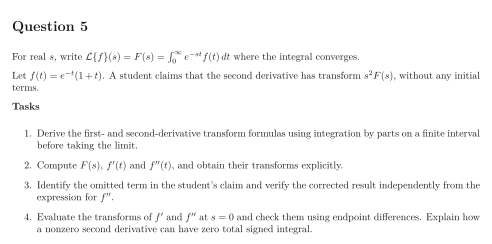
Strategy. Differentiation in time creates boundary terms. Keep them until the initial data and exponential decay have been used.
Step 1: Retain the boundaries. Integration by parts on gives Repeating for and then taking yields provided the upper boundary terms vanish. Here they do for every , since are polynomials times .
Step 2: Compute the functions and transforms. Using elementary exponential integrals, Direct differentiation gives and , with and . Hence These intervals are exact: at or below , the resulting polynomial or growing exponential tails do not have convergent improper integrals.
Step 3: Repair and check the claim. The omitted initial contribution is . Thus the corrected expression is . Independently, transforming gives This agreement verifies both the boundary terms and the algebra.
Step 4: Check zero-parameter integrals. At zero, the first-derivative transform equals , consistent with . The second-derivative transform is zero, consistent with . The function is negative before and positive afterward; its two signed contributions cancel. Zero integral is not the same as a zero function.