Question 1
Use the ordinary one-sided Laplace transform for real . Seek an inverse continuous on and of exponential order; transforms agreeing for all sufficiently large have at most one inverse in this class.
Consider The basic pair holds for .
Tasks
Find the inverse by partial fractions and verify the decomposition.
Determine the full real convergence interval of the recovered function.
Prove that the inverse is positive for all . Does its negative partial-fraction coefficient contradict positivity?
Find its initial value, its unique maximum and its limit at infinity. Explain why a sum of decaying modes need not decrease from the start.
Show solutionHide solution
Question 1 – Solution
Strategy. Resolve the two poles, then factor the resulting time expression before deciding its sign or shape.
Step 1: Resolve and invert. Writing gives and . Thus , , and Transforming these two terms gives , whose numerator is . This verifies the entire rational expression, not just its pole locations.
Step 2: Retain the actual domain. For , both exponential integrals converge absolutely. Since on , its weighted integral diverges for . Hence the exact real domain is ; other algebraic values of are not ordinary transform values.
Step 3: Determine the sign. The factor lies in , so everywhere. The negative coefficient belongs to one term in a decomposition; it does not determine the sign of the whole function. Here the faster-decaying negative term never dominates the positive term.
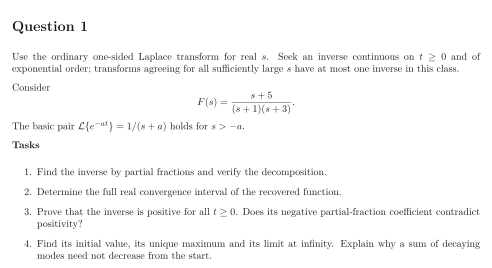
Step 4: Locate the peak. We have , , and The bracket decreases through zero once. Therefore increases up to, then decreases after, In particular : decay of each mode does not force monotonic decay of their signed combination. The graph marks the small but real overshoot.
See the diagram in the original worksheet below.