Question 4
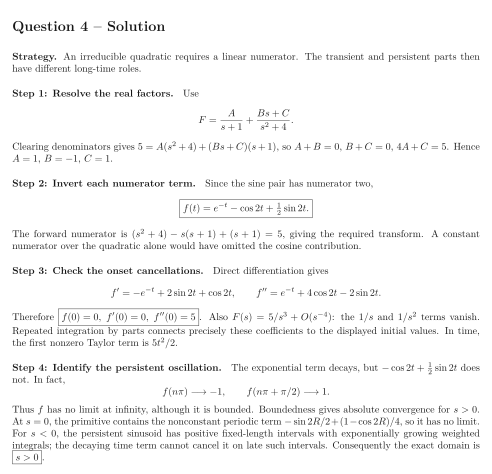
Use the ordinary one-sided Laplace transform for real . Seek an inverse continuous on and of exponential order; transforms agreeing for all sufficiently large have at most one inverse in this class.
Let The required basic pairs are , and .
Tasks
Choose a complete real partial-fraction form and solve for its coefficients.
Find the inverse and verify its forward transform by recombining numerators.
Compute the first three initial quantities . Relate their cancellations to the leading large- behavior of .
Determine the exact real convergence interval. Does the inverse approach a limit as ? Justify your answer using explicit sequences.
Show solutionHide solution
Question 4 – Solution
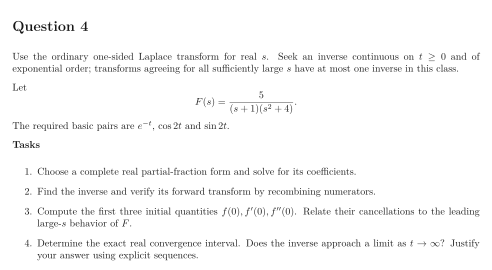
Strategy. An irreducible quadratic requires a linear numerator. The transient and persistent parts then have different long-time roles.
Step 1: Resolve the real factors. Use Clearing denominators gives , so , , . Hence , , .
Step 2: Invert each numerator term. Since the sine pair has numerator two, The forward numerator is , giving the required transform. A constant numerator over the quadratic alone would have omitted the cosine contribution.
Step 3: Check the onset cancellations. Direct differentiation gives Therefore . Also : the and terms vanish. Repeated integration by parts connects precisely these coefficients to the displayed initial values. In time, the first nonzero Taylor term is .
Step 4: Identify the persistent oscillation. The exponential term decays, but does not. In fact, Thus has no limit at infinity, although it is bounded. Boundedness gives absolute convergence for . At , the primitive contains the nonconstant periodic term , so it has no limit. For , the persistent sinusoid has positive fixed-length intervals with exponentially growing weighted integrals; the decaying time term cannot cancel it on late such intervals. Consequently the exact domain is .