Question 10
Use the ordinary one-sided Laplace transform for real . Seek an inverse continuous on and of exponential order; transforms agreeing for all sufficiently large have at most one inverse in this class.
A transform has the form Its inverse satisfies , and . Assume is three times continuously differentiable and are of exponential order, so repeated integration by parts is available.
Tasks
Derive the expansion . Use it to determine .
Find the inverse by partial fractions and verify all three prescribed initial quantities.
Factor the inverse to prove its sign on and determine its exact real convergence interval.
Find its sharp maximum value and the unique time at which it is attained. Explain why the initial data determine the numerator here but would not determine an arbitrary function.
Show solutionHide solution
Question 10 – Solution
Strategy. Initial data determine large-parameter coefficients. The fixed denominator converts those coefficients into a finite algebraic reconstruction.
Step 1: Recover the missing numerator. Three integrations by parts, with vanishing upper boundary terms for sufficiently large , give The last transform is by an exponential bound. Since the denominator is , expansion of the rational expression gives The prescribed values imply .
Step 2: Resolve the three poles and check. Evaluation of the cleared identity at gives coefficients . Hence Their forward numerator is six. The initial derivative sums are , , and , verifying all data.
Step 3: Factor to determine the sign and tail. The useful form is . It is zero at and strictly positive for . Its tail is asymptotic to , so the exact real convergence interval is : above it all terms converge; at or below it the eventually positive weighted tail has infinite integral.
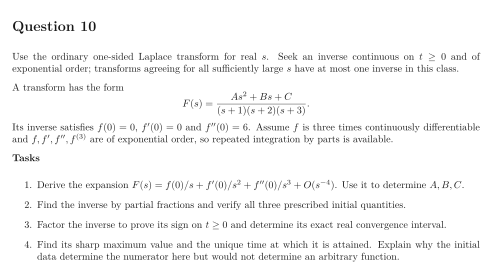
Step 4: Find the sharp peak and scope of reconstruction. Put , so and . Its derivative with respect to is , so the unique interior maximum occurs at : The endpoint values are zero (at and as ). The fixed three-parameter numerator made the reconstruction unique. Adding to this inverse preserves all three initial data but changes its transform and leaves the specified rational family. Thus three initial quantities alone do not determine an arbitrary function.
See the diagram in the original worksheet below.