Question 2
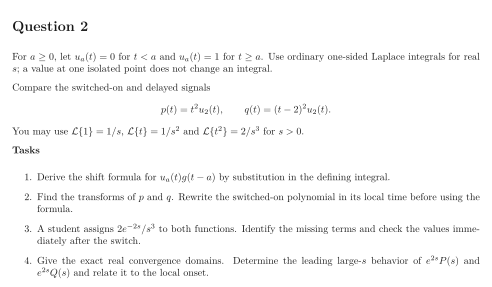
For , let for and for . Use ordinary one-sided Laplace integrals for real ; a value at one isolated point does not change an integral.
Compare the switched-on and delayed signals You may use , and for .
Tasks
Derive the shift formula for by substitution in the defining integral.
Find the transforms of and . Rewrite the switched-on polynomial in its local time before using the formula.
A student assigns to both functions. Identify the missing terms and check the values immediately after the switch.
Give the exact real convergence domains. Determine the leading large- behavior of and and relate it to the local onset.
Show solutionHide solution
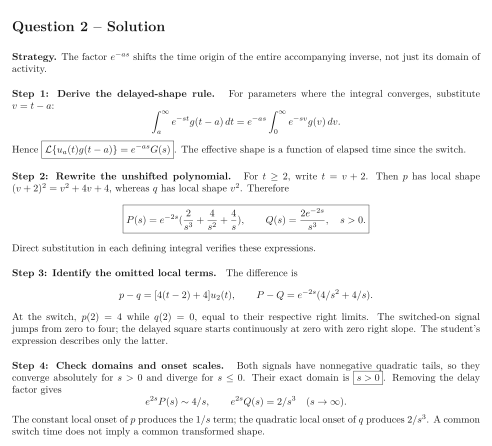
Question 2 – Solution
Strategy. The factor shifts the time origin of the entire accompanying inverse, not just its domain of activity.
Step 1: Derive the delayed-shape rule. For parameters where the integral converges, substitute : Hence . The effective shape is a function of elapsed time since the switch.
Step 2: Rewrite the unshifted polynomial. For , write . Then has local shape , whereas has local shape . Therefore Direct substitution in each defining integral verifies these expressions.
Step 3: Identify the omitted local terms. The difference is At the switch, while , equal to their respective right limits. The switched-on signal jumps from zero to four; the delayed square starts continuously at zero with zero right slope. The student’s expression describes only the latter.
Step 4: Check domains and onset scales. Both signals have nonnegative quadratic tails, so they converge absolutely for and diverge for . Their exact domain is . Removing the delay factor gives The constant local onset of produces the term; the quadratic local onset of produces . A common switch time does not imply a common transformed shape.