Question 2
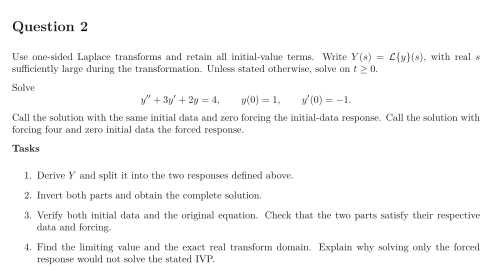
Use one-sided Laplace transforms and retain all initial-value terms. Write , with real sufficiently large during the transformation. Unless stated otherwise, solve on .
Solve Call the solution with the same initial data and zero forcing the initial-data response. Call the solution with forcing four and zero initial data the forced response.
Tasks
Derive and split it into the two responses defined above.
Invert both parts and obtain the complete solution.
Verify both initial data and the original equation. Check that the two parts satisfy their respective data and forcing.
Find the limiting value and the exact real transform domain. Explain why solving only the forced response would not solve the stated IVP.
Show solutionHide solution
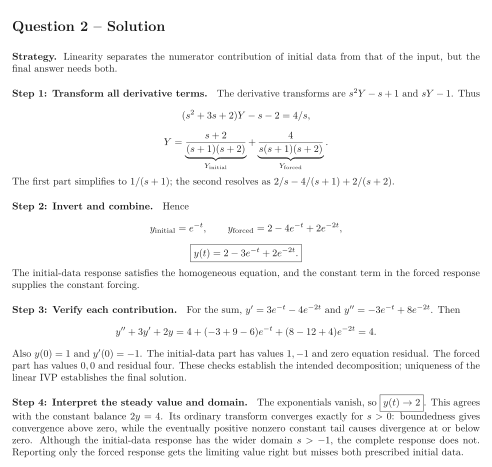
Question 2 – Solution
Strategy. Linearity separates the numerator contribution of initial data from that of the input, but the final answer needs both.
Step 1: Transform all derivative terms. The derivative transforms are and . Thus The first part simplifies to ; the second resolves as .
Step 2: Invert and combine. Hence The initial-data response satisfies the homogeneous equation, and the constant term in the forced response supplies the constant forcing.
Step 3: Verify each contribution. For the sum, and . Then Also and . The initial-data part has values and zero equation residual. The forced part has values and residual four. These checks establish the intended decomposition; uniqueness of the linear IVP establishes the final solution.
Step 4: Interpret the steady value and domain. The exponentials vanish, so . This agrees with the constant balance . Its ordinary transform converges exactly for : boundedness gives convergence above zero, while the eventually positive nonzero constant tail causes divergence at or below zero. Although the initial-data response has the wider domain , the complete response does not. Reporting only the forced response gets the limiting value right but misses both prescribed initial data.