Question 8
Use one-sided Laplace transforms and retain all initial-value terms. Write , with real sufficiently large during the transformation. Unless stated otherwise, solve on .
An accumulated quantity enters an IVP: You may use where the integrals converge.
Tasks
Solve directly by Laplace transforms, including the integral term.
Find an explicit expression for and verify the original equation.
Differentiate the original equation and determine the extra initial condition needed for the resulting second-order equation. Explain why omitting that condition enlarges the solution set.
Find the first positive zero of , its limit, the limit of , and the exact transform domain of . Explain why a constant right-hand side does not force a nonzero limiting here.
Show solutionHide solution
Question 8 – Solution
Strategy. Transform the accumulated state as well as the instantaneous state. Verify the original integral equation after any differentiation.
Step 1: Transform and complete the square. For sufficiently large , the initial value gives Let . Completing the square gives This inverts with the required sine normalization.
Step 2: Reconstruct the integral and verify. Integration, or differentiation of the following expression, gives It satisfies and . Also . Substitution yields identically, and . This checks the undifferentiated problem.
Step 3: Retain the compatibility condition. Differentiation gives . Evaluating the original equation at zero gives . Thus the equivalent second-order IVP has data . If only is retained, a free initial slope remains; it sets the constant value of , which need not be one. Conversely, a solution of the differentiated equation with both correct data makes that quantity constant and equal to one, proving equivalence and uniqueness.
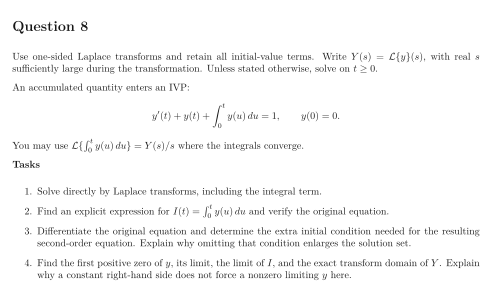
Step 4: Interpret the limiting balance. The first positive zero is . The function changes sign there and tends to zero, while . The accumulated state supplies the limiting balance, rather than a nonzero instantaneous state. The exact domain of is , from the damped sine and its nonconvergent boundary integral. The integral state’s transform needs because ; the initial derivation used this common domain. The wider domain of follows from the recovered function itself.
See the diagram in the original worksheet below.