Question 1
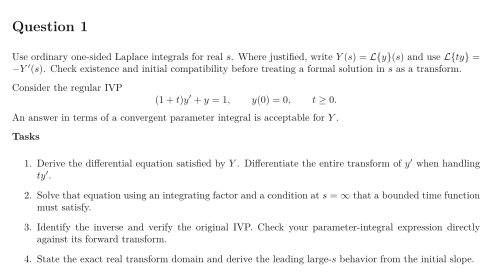
Use ordinary one-sided Laplace integrals for real . Where justified, write and use . Check existence and initial compatibility before treating a formal solution in as a transform.
Consider the regular IVP An answer in terms of a convergent parameter integral is acceptable for .
Tasks
Derive the differential equation satisfied by . Differentiate the entire transform of when handling .
Solve that equation using an integrating factor and a condition at that a bounded time function must satisfy.
Identify the inverse and verify the original IVP. Check your parameter-integral expression directly against its forward transform.
State the exact real transform domain and derive the leading large- behavior from the initial slope.
Show solutionHide solution
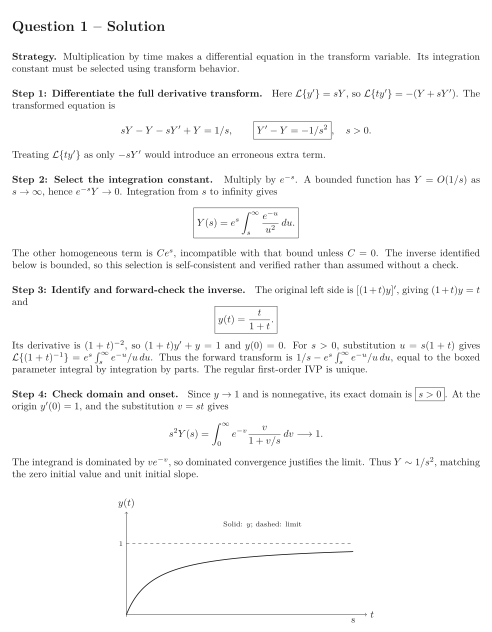
Question 1 – Solution
Strategy. Multiplication by time makes a differential equation in the transform variable. Its integration constant must be selected using transform behavior.
Step 1: Differentiate the full derivative transform. Here , so . The transformed equation is Treating as only would introduce an erroneous extra term.
Step 2: Select the integration constant. Multiply by . A bounded function has as , hence . Integration from to infinity gives The other homogeneous term is , incompatible with that bound unless . The inverse identified below is bounded, so this selection is self-consistent and verified rather than assumed without a check.
Step 3: Identify and forward-check the inverse. The original left side is , giving and Its derivative is , so and . For , substitution gives . Thus the forward transform is , equal to the boxed parameter integral by integration by parts. The regular first-order IVP is unique.
Step 4: Check domain and onset. Since and is nonnegative, its exact domain is . At the origin , and the substitution gives The integrand is dominated by , so dominated convergence justifies the limit. Thus , matching the zero initial value and unit initial slope.
See the diagram in the original worksheet below.