Question 4
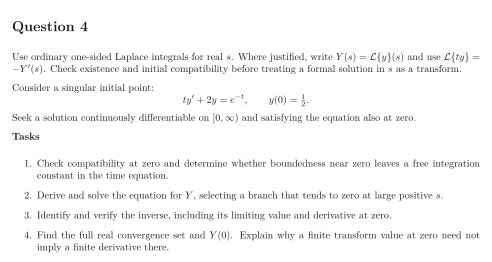
Use ordinary one-sided Laplace integrals for real . Where justified, write and use . Check existence and initial compatibility before treating a formal solution in as a transform.
Consider a singular initial point: Seek a solution continuously differentiable on and satisfying the equation also at zero.
Tasks
Check compatibility at zero and determine whether boundedness near zero leaves a free integration constant in the time equation.
Derive and solve the equation for , selecting a branch that tends to zero at large positive .
Identify and verify the inverse, including its limiting value and derivative at zero.
Find the full real convergence set and . Explain why a finite transform value at zero need not imply a finite derivative there.
Show solutionHide solution
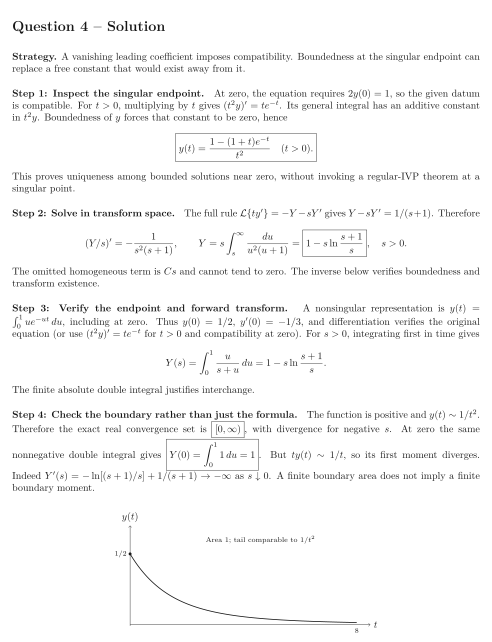
Question 4 – Solution
Strategy. A vanishing leading coefficient imposes compatibility. Boundedness at the singular endpoint can replace a free constant that would exist away from it.
Step 1: Inspect the singular endpoint. At zero, the equation requires , so the given datum is compatible. For , multiplying by gives . Its general integral has an additive constant in . Boundedness of forces that constant to be zero, hence This proves uniqueness among bounded solutions near zero, without invoking a regular-IVP theorem at a singular point.
Step 2: Solve in transform space. The full rule gives . Therefore The omitted homogeneous term is and cannot tend to zero. The inverse below verifies boundedness and transform existence.
Step 3: Verify the endpoint and forward transform. A nonsingular representation is , including at zero. Thus , , and differentiation verifies the original equation (or use for and compatibility at zero). For , integrating first in time gives The finite absolute double integral justifies interchange.
Step 4: Check the boundary rather than just the formula. The function is positive and . Therefore the exact real convergence set is , with divergence for negative . At zero the same nonnegative double integral gives . But , so its first moment diverges. Indeed as . A finite boundary area does not imply a finite boundary moment.
See the diagram in the original worksheet below.