Question 5
Use ordinary one-sided Laplace integrals for real . Where justified, write and use . Check existence and initial compatibility before treating a formal solution in as a transform.
Seek a twice continuously differentiable solution of including at . When checking the transform boundary, you may use the estimate for , uniformly for , obtained by integration by parts.
Tasks
Determine the initial slope forced by the equation at zero, then derive the differential equation for .
Solve for on using its decay at infinity and identify the inverse.
Use to verify the equation and prove uniqueness in the stated smooth class. Explain why the initial slope disappeared from the transformed equation.
Find the exact real transform domain, including the ordinary boundary value at zero. Use the supplied uniform tail estimate to justify passage to that value.
Show solutionHide solution
Question 5 – Solution
Strategy. The singular equation fixes a missing initial slope. Transform differentiation removes that slope algebraically, so compatibility must be checked separately.
Step 1: Recover compatibility and transform. At zero the equation requires . Since adding and gives
Step 2: Select and identify the inverse. The condition as gives The time function has representation . Transforming this integral for yields . Absolute double integrability justifies the interchange.
Step 3: Verify smoothness and uniqueness. The expansion supplies a smooth extension with slope zero. Set . Then , with , . The regular oscillator IVP has the unique solution , proving the original equation and uniqueness of its smooth extension. The term is constant in , so it disappears when differentiating the transform of ; arbitrary initial slopes are nevertheless not admissible.
Step 4: Establish the boundary value. The supplied estimate makes the tails uniformly small for . On each fixed finite interval the damped integrals converge to the undamped one as . Taking the interval long first and then taking proves The boundary integral is conditional: intervals where give a divergent harmonic lower bound for its absolute integral. For , fixed-length positive lobe intervals have weighted integrals growing like , violating the Cauchy criterion. The exact real domain is .
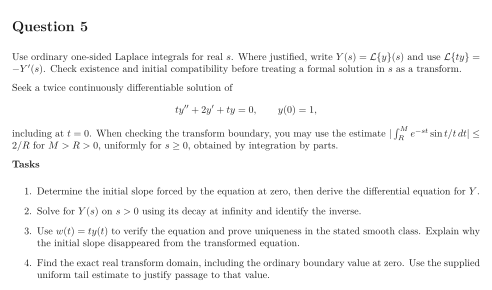
See the diagram in the original worksheet below.