Question 2
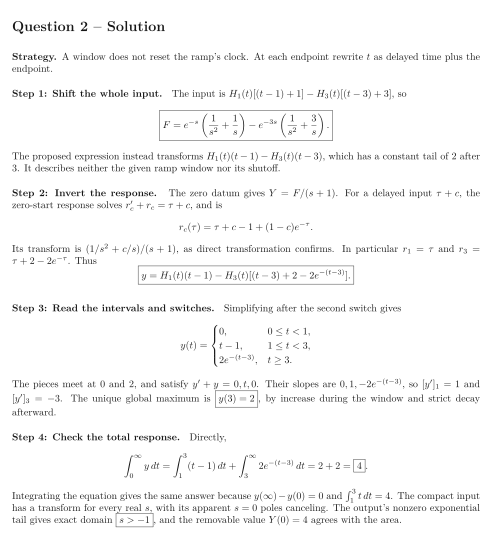
Let for and for . Use one-sided Laplace transforms. Solutions are continuous (and have continuous first derivative for second-order equations); satisfy the equation away from switches and use one-sided derivatives there. Isolated input values do not change the solution.
A ramp is switched on without resetting its clock, then switched off: A proposed input transform is .
Tasks
Explain the error in the proposed transform and derive the correct .
Find and invert it, rewriting each active input in its own delayed time.
Give the piecewise solution, its maximum, and the two jumps in .
Compute directly and from the differential equation. Explain the apparent singularities in the transform formula.
Show solutionHide solution
Question 2 – Solution
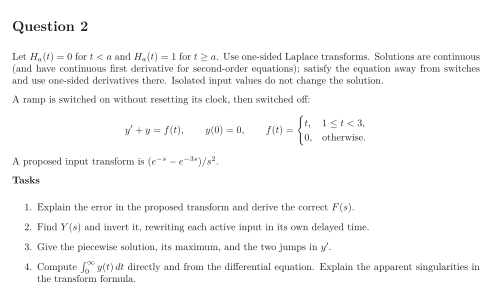
Strategy. A window does not reset the ramp’s clock. At each endpoint rewrite as delayed time plus the endpoint.
Step 1: Shift the whole input. The input is , so The proposed expression instead transforms , which has a constant tail of after . It describes neither the given ramp window nor its shutoff.
Step 2: Invert the response. The zero datum gives . For a delayed input , the zero-start response solves , and is Its transform is , as direct transformation confirms. In particular and . Thus
Step 3: Read the intervals and switches. Simplifying after the second switch gives The pieces meet at and , and satisfy . Their slopes are , so and . The unique global maximum is , by increase during the window and strict decay afterward.
Step 4: Check the total response. Directly, Integrating the equation gives the same answer because and . The compact input has a transform for every real , with its apparent poles canceling. The output’s nonzero exponential tail gives exact domain , and the removable value agrees with the area.