Question 7
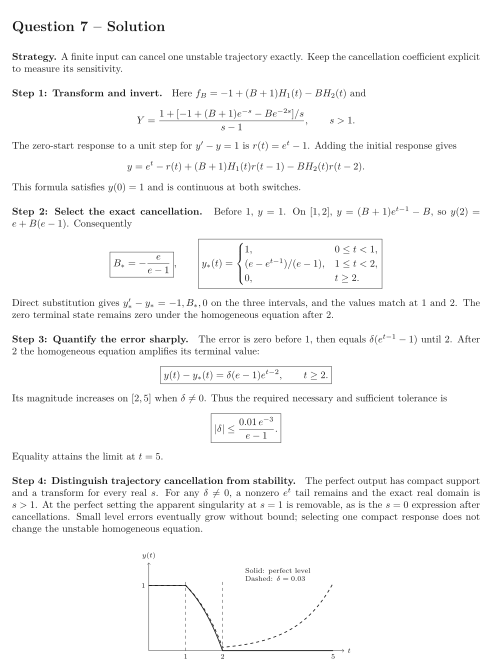
Let for and for . Use one-sided Laplace transforms. Solutions are continuous (and have continuous first derivative for second-order equations); satisfy the equation away from switches and use one-sided derivatives there. Isolated input values do not change the solution.
An unstable first-order system is to be stopped by a two-stage input: Choose so that for all . A realized level may instead be , where is a constant error.
Tasks
Find and invert it using the unstable system’s step response.
Determine and the resulting piecewise output. Verify the stopping condition.
Derive the exact output error for and the sharp bound on that ensures for every .
Compare the exact real transform domains for perfect and imperfect levels. Explain why exact cancellation does not make the system stable.
Show solutionHide solution
Question 7 – Solution
Strategy. A finite input can cancel one unstable trajectory exactly. Keep the cancellation coefficient explicit to measure its sensitivity.
Step 1: Transform and invert. Here and The zero-start response to a unit step for is . Adding the initial response gives This formula satisfies and is continuous at both switches.
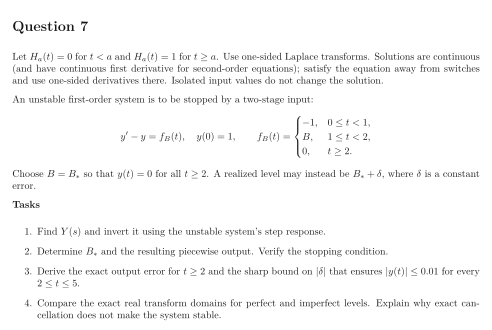
Step 2: Select the exact cancellation. Before , . On , , so . Consequently Direct substitution gives on the three intervals, and the values match at and . The zero terminal state remains zero under the homogeneous equation after .
Step 3: Quantify the error sharply. The error is zero before , then equals until . After the homogeneous equation amplifies its terminal value: Its magnitude increases on when . Thus the required necessary and sufficient tolerance is Equality attains the limit at .
Step 4: Distinguish trajectory cancellation from stability. The perfect output has compact support and a transform for every real . For any , a nonzero tail remains and the exact real domain is . At the perfect setting the apparent singularity at is removable, as is the expression after cancellations. Small level errors eventually grow without bound; selecting one compact response does not change the unstable homogeneous equation.
See the diagram in the original worksheet below.