Question 9
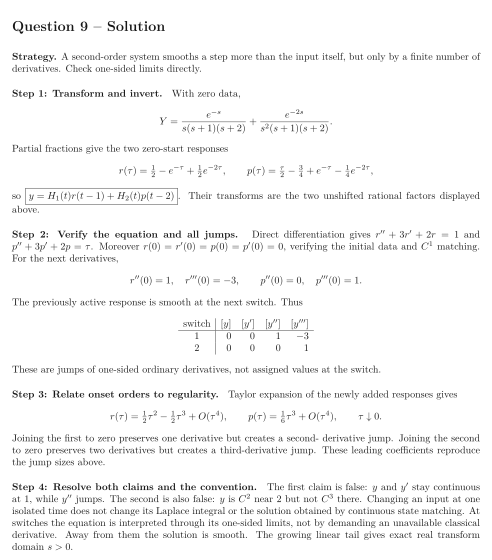
Let for and for . Use one-sided Laplace transforms. Solutions are continuous (and have continuous first derivative for second-order equations); satisfy the equation away from switches and use one-sided derivatives there. Isolated input values do not change the solution.
Consider two qualitatively different input changes: One claim says that the jump at makes jump; another says that because the ramp is continuous at , the solution must be smooth to every order there.
Tasks
Find and invert it explicitly using the step and ramp responses.
Verify the original IVP and determine the jumps in at and .
Derive the leading small- behavior of each newly activated response. Relate the orders of onset to the jump calculations.
Evaluate both claims and explain whether a different assigned value of changes the response.
Show solutionHide solution
Question 9 – Solution
Strategy. A second-order system smooths a step more than the input itself, but only by a finite number of derivatives. Check one-sided limits directly.
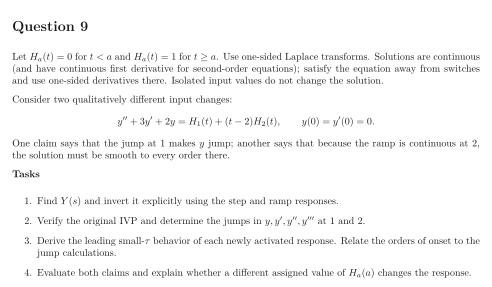
Step 1: Transform and invert. With zero data, Partial fractions give the two zero-start responses so . Their transforms are the two unshifted rational factors displayed above.
Step 2: Verify the equation and all jumps. Direct differentiation gives and . Moreover , verifying the initial data and matching. For the next derivatives, The previously active response is smooth at the next switch. Thus These are jumps of one-sided ordinary derivatives, not assigned values at the switch.
Step 3: Relate onset orders to regularity. Taylor expansion of the newly added responses gives Joining the first to zero preserves one derivative but creates a second- derivative jump. Joining the second to zero preserves two derivatives but creates a third-derivative jump. These leading coefficients reproduce the jump sizes above.
Step 4: Resolve both claims and the convention. The first claim is false: and stay continuous at , while jumps. The second is also false: is near but not there. Changing an input at one isolated time does not change its Laplace integral or the solution obtained by continuous state matching. At switches the equation is interpreted through its one-sided limits, not by demanding an unavailable classical derivative. Away from them the solution is smooth. The growing linear tail gives exact real transform domain .