Question 3
Use causal one-sided Laplace transforms. Write for and for . The unit impulse satisfies for continuous near . Interpret equations between impulses and through their jump conditions; use right-hand values at jumps. Write for a jump.
An oscillator moving through equilibrium receives an impulse: For unit mass, use . Ordinary impulses in a second-order equation keep displacement continuous but may jump velocity.
Tasks
Derive the velocity jump and find and .
Compute the states immediately before and after the impulse and simplify the subsequent motion.
Find the energy change and derive the general energy-change formula for an impulse of strength at this same time.
For , classify when the impulse lowers the energy, preserves it, or raises it. Identify the unique strength that brings this oscillator completely to rest.
Show solutionHide solution
Question 3 – Solution
Strategy. The impulse changes velocity, not displacement. Its work depends on the velocity immediately before the kick as well as its strength.
Step 1: Jump, transform and invert. Integrating across gives , because the integral of tends to zero. With , the transformed equation is The new term vanishes at activation, while its derivative starts at . Both pieces satisfy away from and retain the initial data.
Step 2: Evaluate the state at impact. Since , For , the pre-existing response is , so the total post-impact motion is . Thus the impulse reverses the direction and doubles the amplitude.
Step 3: Compute the energy transfer. The energies are and , giving . For any impulse , continuity of position and imply At this impact time , hence
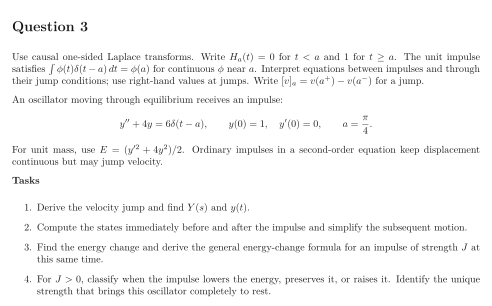
Step 4: Classify the positive kicks. For the energy decreases; at it is unchanged; for it increases. A positive impulse can remove energy when it opposes the incoming velocity. Complete rest requires both post-impact state coordinates to vanish. Position is already zero here, so the unique strength is , which makes velocity zero. A zero velocity kick at a nonzero displacement would not in general leave an oscillator at rest. The plot shows the stated case, with continuous displacement and a corner.
See the diagram in the original worksheet below.