Question 5
Use causal one-sided Laplace transforms. Write for and for . The unit impulse satisfies for continuous near . Interpret equations between impulses and through their jump conditions; use right-hand values at jumps. Write for a jump.
Two impulses act on an initially resting undamped oscillator: Require complete rest after the second impulse.
Tasks
Find the transformed response and the time-domain solution.
Classify all delays and strengths that meet the rest condition.
If must be positive, find the earliest possible second impulse. Explain why the net impulse need not be zero.
Keep this earliest positive strength, but deliver it at , where . Find the residual amplitude and its leading behavior as .
Show solutionHide solution
Question 5 – Solution
Strategy. The second kick must occur at a zero of displacement, then cancel the incoming velocity. Timing errors leave a measurable residual oscillation.
Step 1: Transform and invert. For , Each activated sine is zero initially, with derivative equal to its impulse strength. Thus is continuous and , .
Step 2: Impose both state conditions. For , the pre-impact state is Displacement cannot jump. Therefore complete rest requires and is ensured by After these jumps the homogeneous oscillator has zero data, so it remains zero. The corresponding output has compact support and a transform for every real .
Step 3: Restrict the second impulse to be positive. Positive requires odd . The earliest choice is . The net applied impulse is , yet the oscillator stops: during the intervening motion the restoring force also changes momentum. Indeed , balancing the applied impulses in the integrated equation. Ignoring this force would give an incorrect momentum test.
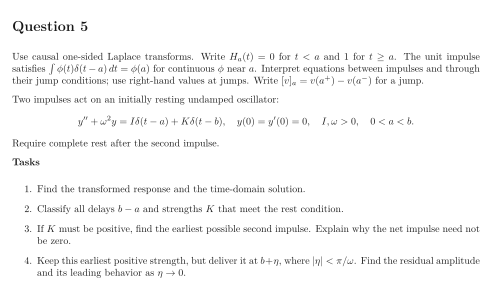
Step 4: Quantify a timing error. At the actual second kick the age is . The state immediately afterward is The subsequent homogeneous amplitude is For every nonzero in the stated interval this amplitude is positive, so the tail’s exact real transform domain is . The plot compares perfect timing and for .
See the diagram in the original worksheet below.