Question 1
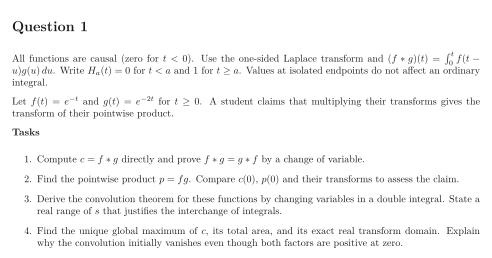
All functions are causal (zero for ). Use the one-sided Laplace transform and . Write for and for . Values at isolated endpoints do not affect an ordinary integral.
Let and for . A student claims that multiplying their transforms gives the transform of their pointwise product.
Tasks
Compute directly and prove by a change of variable.
Find the pointwise product . Compare , and their transforms to assess the claim.
Derive the convolution theorem for these functions by changing variables in a double integral. State a real range of that justifies the interchange of integrals.
Find the unique global maximum of , its total area, and its exact real transform domain. Explain why the convolution initially vanishes even though both factors are positive at zero.
Show solutionHide solution
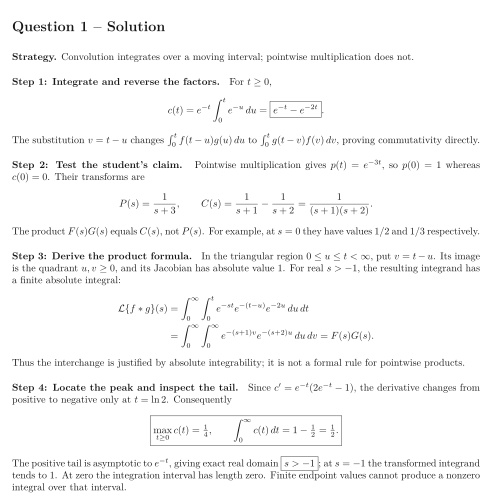
Question 1 – Solution
Strategy. Convolution integrates over a moving interval; pointwise multiplication does not.
Step 1: Integrate and reverse the factors. For , The substitution changes to , proving commutativity directly.
Step 2: Test the student’s claim. Pointwise multiplication gives , so whereas . Their transforms are The product equals , not . For example, at they have values and respectively.
Step 3: Derive the product formula. In the triangular region , put . Its image is the quadrant , and its Jacobian has absolute value . For real , the resulting integrand has a finite absolute integral: Thus the interchange is justified by absolute integrability; it is not a formal rule for pointwise products.
Step 4: Locate the peak and inspect the tail. Since , the derivative changes from positive to negative only at . Consequently The positive tail is asymptotic to , giving exact real domain ; at the transformed integrand tends to . At zero the integration interval has length zero. Finite endpoint values cannot produce a nonzero integral over that interval.