Convolution Integrals — Question 10

PDF ↗

Question 10

All functions are causal (zero for t<0t<0). Use the one-sided Laplace transform and (f*g)(t)=∫0tf(t−u)g(u)du(f*g)(t)=\int_0^t f(t-u)g(u)\,du. Write Ha(t)=0H_a(t)=0 for t<at<a and 11 for t≥at\ge a. Values at isolated endpoints do not affect an ordinary integral.

Let f∈C1[0,∞)f\in C^1[0,\infty) satisfy |f′(t)|≤L|f'(t)|\le L, with L≥0L\ge 0. For ε>0\varepsilon>0 define kε(t)=1εe−t/ε,yε=kε*f.k_\varepsilon(t)=\frac 1\varepsilon e^{-t/\varepsilon},\qquad y_\varepsilon=k_\varepsilon*f. This causal averaging kernel becomes concentrated near zero as ε\varepsilon decreases.

Tasks

  1. Derive an IVP for yεy_\varepsilon and use integration by parts to express yε−fy_\varepsilon-f in terms of f(0)f(0) and f′f'.

  2. Prove an explicit error bound containing both the initial transient and a term at most LεL\varepsilon.

  3. Distinguish uniform convergence on [0,∞)[0,\infty) from uniform convergence on [t0,∞)[t_0,\infty) for t0>0t_0>0. Show the LεL\varepsilon bound is sharp when f(0)=0f(0)=0.

  4. For f(t)=1+tf(t)=1+t, decide separately whether ε=1/20\varepsilon=1/20 and ε=1/40\varepsilon=1/40 ensure |yε(t)−f(t)|≤1/20|y_\varepsilon(t)-f(t)|\le 1/20 for every t≥1t\ge 1. Justify the strict inequalities involved.
Original worksheet page 1: question and worked solution for 4-9-010
Show solutionHide solution

Question 10 – Solution

Strategy. Separate the error due to starting from rest from the error due to variation of the input.

Step 1: Obtain the equation and exact error identity. Differentiation gives εyε′+yε=f\varepsilon y_\varepsilon'+y_\varepsilon=f, yε(0)=0y_\varepsilon(0)=0. Integrating the convolution by parts in uu gives yε(t)−f(t)=−e−t/εf(0)−∫0te−(t−u)/εf′(u)du.y_\varepsilon(t)-f(t)=-e^{-t/\varepsilon}f(0) -\int_0^t e^{-(t-u)/\varepsilon}f'(u)\,du.

Step 2: Bound the two contributions. Taking absolute values yields |yε−f|≤|f(0)|e−t/ε+Lε(1−e−t/ε).\boxed{|y_\varepsilon-f|\le |f(0)|e^{-t/\varepsilon} +L\varepsilon(1-e^{-t/\varepsilon}).} This accounts for the kernel mass missing before time zero as well as the variation over its recent history.

Step 3: Distinguish the convergence statements. If f(0)=0f(0)=0, the error is uniformly at most LεL\varepsilon on the half-line. For the ramp f=Ltf=Lt it equals Lε(1−e−t/ε)L\varepsilon(1-e^{-t/\varepsilon}) in magnitude, whose supremum is LεL\varepsilon (approached as t→∞t\to\infty when L>0L>0). Thus the constant is sharp. If f(0)≠0f(0)\ne 0, the error at zero is always |f(0)||f(0)|, preventing uniform convergence on [0,∞)[0,\infty). On [t0,∞)[t_0,\infty) it is bounded by |f(0)|e−t0/ε+Lε→0|f(0)|e^{-t_0/\varepsilon}+L\varepsilon\to 0 for every fixed t0>0t_0>0.

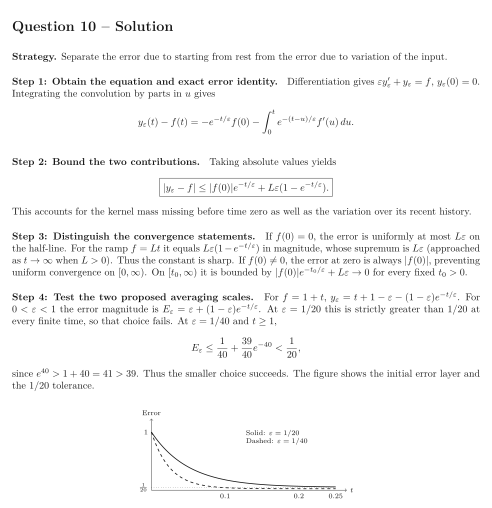
Step 4: Test the two proposed averaging scales. For f=1+tf=1+t, yε=t+1−ε−(1−ε)e−t/εy_\varepsilon=t+1-\varepsilon-(1-\varepsilon)e^{-t/\varepsilon}. For 0<ε<10<\varepsilon<1 the error magnitude is Eε=ε+(1−ε)e−t/εE_\varepsilon=\varepsilon+(1-\varepsilon)e^{-t/\varepsilon}. At ε=1/20\varepsilon=1/20 this is strictly greater than 1/201/20 at every finite time, so that choice fails. At ε=1/40\varepsilon=1/40 and t≥1t\ge 1, Eε≤140+3940e−40<120,E_\varepsilon\le\frac 1{40}+\frac{39}{40}e^{-40}<\frac 1{20}, since e40>1+40=41>39e^{40}>1+40=41>39. Thus the smaller choice succeeds. The figure shows the initial error layer and the 1/201/20 tolerance.

See the diagram in the original worksheet below.
Original worksheet page 2: question and worked solution for 4-9-010

Original worksheet layout. Use Enlarge or open the PDF for a closer view.