Question 2
Work over the real numbers. Use substitution or elimination, keeping track of conditions under which an operation preserves all solutions. Check candidates in the original equations.
For real , solve
Tasks
Use the sum and difference of the equations to classify the solution set for every .
Explain why dividing by or before checking their zeros can lose entire cases. Verify the exceptional cases directly.
Find the limits of the unique solution as and as from either side. Compare these limits with the solution sets at the exceptional values.
Classify all for which a solution with exists, giving the full nonnegative solution set whenever it is not a single point.
Show solutionHide solution
Question 2 – Solution
Strategy. Adding and subtracting separates the sum of the unknowns from their difference, exposing both exceptional parameter values.
Step 1: Reduce reversibly. The sum and difference equations are They are equivalent to the originals: taking half their sum and half their difference recovers the two original equations. If , then At , the sum is , giving no solution. At , only remains, giving infinitely many solutions.
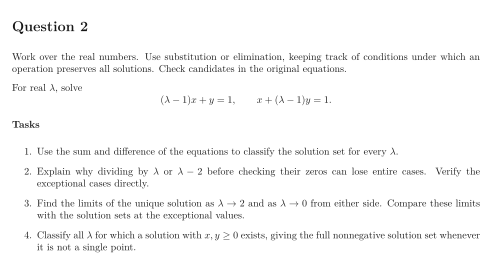
Step 2: Retain the exceptional equations. Directly, gives and , incompatible parallel lines. At , both equations become . Dividing by a factor that can be zero discards these cases rather than solving them. The figure displays the two exceptional geometries.
Step 3: Compare limits with exact parameter values. As through the unique-solution cases, . This is one point of the entire line present at , not the whole limiting parameter’s solution set. As both coordinates increase without bound; as both decrease without bound. There is no finite limiting solution, consistent with the contradiction at zero.
Step 4: Enforce nonnegativity. For , the solution is nonnegative exactly when . At , the nonnegative solutions are , . Therefore a nonnegative solution exists exactly for , with the entire stated segment at .
See the diagram in the original worksheet below.