Question 7
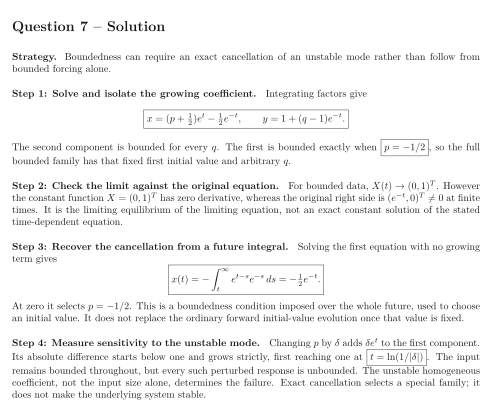
On , consider the bounded input in Investigate which initial states suppress the unstable homogeneous mode.
Tasks
Find the complete solution and classify every initial state yielding a bounded forward response.
Find the limiting state for those bounded solutions. Is that limiting vector, held constant, itself a solution of the original forced equation?
Express the bounded first component using an integral from the current time to infinity. Explain how this condition selects its initial value.
Perturb the selected initial first component by , with . Find when its difference from the bounded response first reaches magnitude one. Does bounded forcing ensure bounded responses here?
Show solutionHide solution
Question 7 – Solution
Strategy. Boundedness can require an exact cancellation of an unstable mode rather than follow from bounded forcing alone.
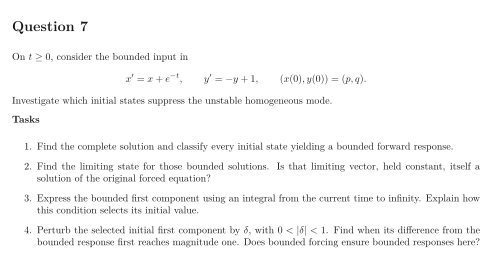
Step 1: Solve and isolate the growing coefficient. Integrating factors give The second component is bounded for every . The first is bounded exactly when , so the full bounded family has that fixed first initial value and arbitrary .
Step 2: Check the limit against the original equation. For bounded data, . However the constant function has zero derivative, whereas the original right side is at finite times. It is the limiting equilibrium of the limiting equation, not an exact constant solution of the stated time-dependent equation.
Step 3: Recover the cancellation from a future integral. Solving the first equation with no growing term gives At zero it selects . This is a boundedness condition imposed over the whole future, used to choose an initial value. It does not replace the ordinary forward initial-value evolution once that value is fixed.
Step 4: Measure sensitivity to the unstable mode. Changing by adds to the first component. Its absolute difference starts below one and grows strictly, first reaching one at . The input remains bounded throughout, but every such perturbed response is unbounded. The unstable homogeneous coefficient, not the input size alone, determines the failure. Exact cancellation selects a special family; it does not make the underlying system stable.