Question 5
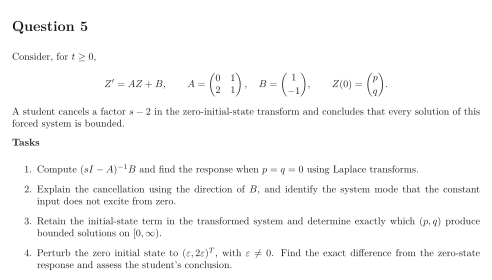
Consider, for , A student cancels a factor in the zero-initial-state transform and concludes that every solution of this forced system is bounded.
Tasks
Compute and find the response when using Laplace transforms.
Explain the cancellation using the direction of , and identify the system mode that the constant input does not excite from zero.
Retain the initial-state term in the transformed system and determine exactly which produce bounded solutions on .
Perturb the zero initial state to , with . Find the exact difference from the zero-state response and assess the student’s conclusion.
Show solutionHide solution
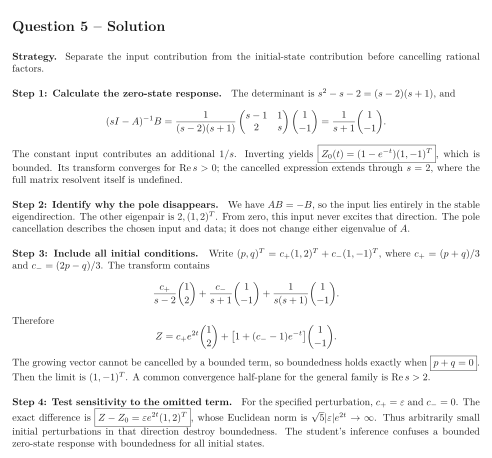
Question 5 – Solution
Strategy. Separate the input contribution from the initial-state contribution before cancelling rational factors.
Step 1: Calculate the zero-state response. The determinant is , and The constant input contributes an additional . Inverting yields , which is bounded. Its transform converges for ; the cancelled expression extends through , where the full matrix resolvent itself is undefined.
Step 2: Identify why the pole disappears. We have , so the input lies entirely in the stable eigendirection. The other eigenpair is . From zero, this input never excites that direction. The pole cancellation describes the chosen input and data; it does not change either eigenvalue of .
Step 3: Include all initial conditions. Write , where and . The transform contains Therefore The growing vector cannot be cancelled by a bounded term, so boundedness holds exactly when . Then the limit is . A common convergence half-plane for the general family is .
Step 4: Test sensitivity to the omitted term. For the specified perturbation, and . The exact difference is , whose Euclidean norm is . Thus arbitrarily small initial perturbations in that direction destroy boundedness. The student’s inference confuses a bounded zero-state response with boundedness for all initial states.