Question 1
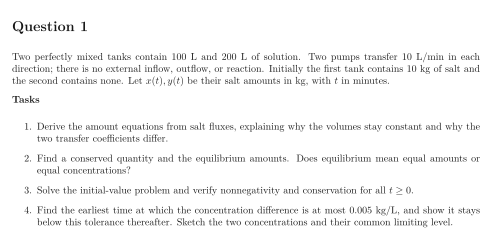
Two perfectly mixed tanks contain L and L of solution. Two pumps transfer L/min in each direction; there is no external inflow, outflow, or reaction. Initially the first tank contains kg of salt and the second contains none. Let be their salt amounts in kg, with in minutes.
Tasks
Derive the amount equations from salt fluxes, explaining why the volumes stay constant and why the two transfer coefficients differ.
Find a conserved quantity and the equilibrium amounts. Does equilibrium mean equal amounts or equal concentrations?
Solve the initial-value problem and verify nonnegativity and conservation for all .
Find the earliest time at which the concentration difference is at most kg/L, and show it stays below this tolerance thereafter. Sketch the two concentrations and their common limiting level.
Show solutionHide solution
Question 1 – Solution
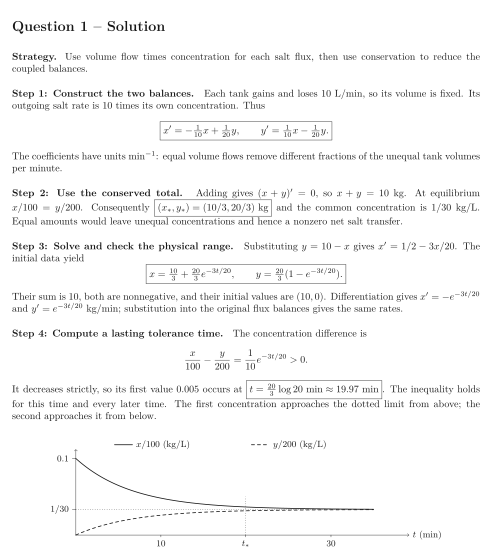
Strategy. Use volume flow times concentration for each salt flux, then use conservation to reduce the coupled balances.
Step 1: Construct the two balances. Each tank gains and loses L/min, so its volume is fixed. Its outgoing salt rate is times its own concentration. Thus The coefficients have units min: equal volume flows remove different fractions of the unequal tank volumes per minute.
Step 2: Use the conserved total. Adding gives , so kg. At equilibrium . Consequently and the common concentration is kg/L. Equal amounts would leave unequal concentrations and hence a nonzero net salt transfer.
Step 3: Solve and check the physical range. Substituting gives . The initial data yield Their sum is , both are nonnegative, and their initial values are . Differentiation gives and kg/min; substitution into the original flux balances gives the same rates.
Step 4: Compute a lasting tolerance time. The concentration difference is It decreases strictly, so its first value occurs at . The inequality holds for this time and every later time. The first concentration approaches the dotted limit from above; the second approaches it from below.
See the diagram in the original worksheet below.