Question 3
Two uniform bodies each have heat capacity kJ/C. Their mutual thermal conductance is kJ/(minC), and each has that same conductance to a room maintained at C. Heat flow equals conductance times temperature difference; there are no internal heat sources. Initially C and C. Time is in minutes.
Tasks
Derive the two energy balances. Introduce excess temperatures and write the homogeneous system.
Find the total excess thermal energy and its decay law. Explain which heat transfers cancel in this sum.
Solve for both temperatures. Find the exact maximum temperature of the initially cooler body and when it occurs.
Explain why one body can warm while total excess energy decreases. Prove neither body leaves the interval C, and sketch the temperatures.
Show solutionHide solution
Question 3 – Solution
Strategy. Write heat-capacity balances before shifting the reference temperature; sum and difference variables isolate two decay rates.
Step 1: Balance heat for each body. For body 1, capacity times equals in kJ/min; the analogous balance holds for body 2. Hence The numerical decay coefficients have units min.
Step 2: Track total excess energy. With each capacity equal to kJ/C, excess energy is numerically in kJ. Interbody exchange cancels, leaving and . Only heat delivered to the room decreases this total.
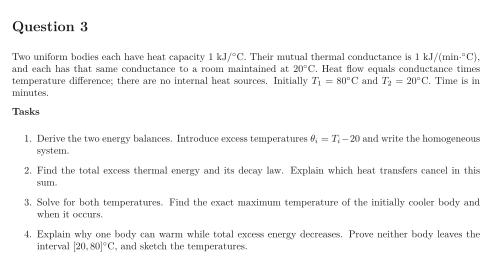
Step 3: Solve the modes and locate the warm-up peak. The difference obeys . Together with the sum this gives Here , which changes sign from positive to negative at . Therefore
Step 4: Reconcile local warming with total cooling. Initially the hotter body supplies heat to body 2 faster than body 2 loses heat to the room. Nevertheless throughout. The formulas give and , so each temperature stays in C. Both tend to room temperature; the second has a genuine temporary maximum, not a higher final equilibrium.
See the diagram in the original worksheet below.