Question 7
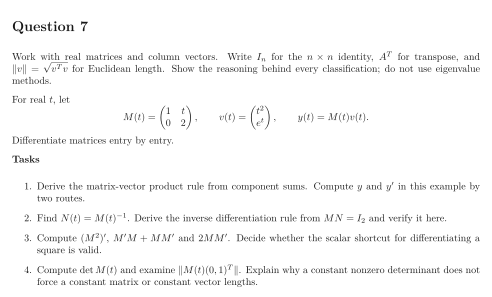
Work with real matrices and column vectors. Write for the identity, for transpose, and for Euclidean length. Show the reasoning behind every classification; do not use eigenvalue methods.
For real , let Differentiate matrices entry by entry.
Tasks
Derive the matrix-vector product rule from component sums. Compute and in this example by two routes.
Find . Derive the inverse differentiation rule from and verify it here.
Compute , and . Decide whether the scalar shortcut for differentiating a square is valid.
Compute and examine . Explain why a constant nonzero determinant does not force a constant matrix or constant vector lengths.
Show solutionHide solution
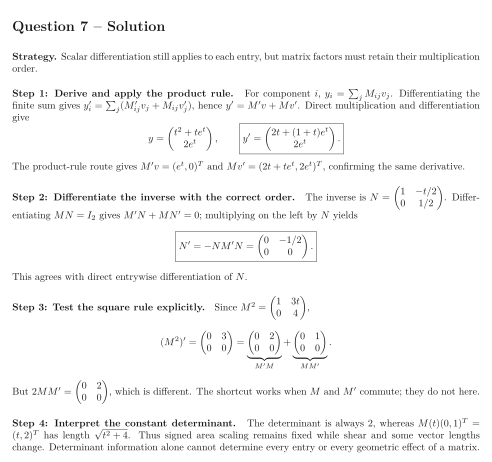
Question 7 – Solution
Strategy. Scalar differentiation still applies to each entry, but matrix factors must retain their multiplication order.
Step 1: Derive and apply the product rule. For component , . Differentiating the finite sum gives , hence . Direct multiplication and differentiation give The product-rule route gives and , confirming the same derivative.
Step 2: Differentiate the inverse with the correct order. The inverse is . Differentiating gives ; multiplying on the left by yields This agrees with direct entrywise differentiation of .
Step 3: Test the square rule explicitly. Since , But , which is different. The shortcut works when and commute; they do not here.
Step 4: Interpret the constant determinant. The determinant is always , whereas has length . Thus signed area scaling remains fixed while shear and some vector lengths change. Determinant information alone cannot determine every entry or every geometric effect of a matrix.