Question 6
An eigenpair satisfies with . The eigenspace includes zero, although zero is not an eigenvector. Algebraic multiplicity counts roots of ; geometric multiplicity is . Work over unless complex scalars are explicitly requested.
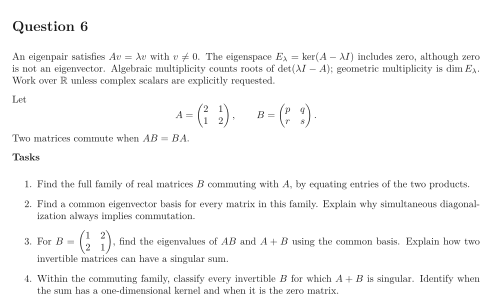
Let Two matrices commute when .
Tasks
Find the full family of real matrices commuting with , by equating entries of the two products.
Find a common eigenvector basis for every matrix in this family. Explain why simultaneous diagonalization always implies commutation.
For , find the eigenvalues of and using the common basis. Explain how two invertible matrices can have a singular sum.
Within the commuting family, classify every invertible for which is singular. Identify when the sum has a one-dimensional kernel and when it is the zero matrix.
Show solutionHide solution
Question 6 – Solution
Strategy. Commutation forces preservation of this matrix’s two distinct eigendirections, allowing scalar tests in a common basis.
Step 1: Equate the products. Subtracting the products gives Thus and , with no further restrictions. Thus the entire commuting family is .
Step 2: Use the common directions. For and , the eigenvalues of are , and those of are , respectively. These independent vectors form a common eigenvector basis, even if the two eigenvalues of coincide. Conversely, if and with diagonal, then .
Step 3: Analyze the concrete sum and product. For , the eigenvalues of on are . Therefore the eigenvalues of are and those of are . Both and are invertible, but their actions on cancel in the sum. The sum has kernel .
Step 4: Classify all cancellation cases. Invertibility of requires . Singularity of the sum requires . Equivalently the full allowed set is On the first line only, the kernel is the line through ; on the second only, it is the line through . Their intersection is , where and , so the kernel is the entire plane. The excluded points are and , where itself is singular. The diagram marks these exclusions with open circles.
See the diagram in the original worksheet below.
