Question 7
An eigenpair satisfies with . The eigenspace includes zero, although zero is not an eigenvector. Algebraic multiplicity counts roots of ; geometric multiplicity is . Work over unless complex scalars are explicitly requested.
For a real parameter , let Both eigenvalues have magnitude less than one. We compare long-term iteration with the stronger requirement for every real vector .
Tasks
Find an eigenvector basis for every and determine whether the matrix is diagonalizable.
Derive for every nonnegative integer and prove that every fixed starting vector tends to zero under iteration.
For the starting vector , find the first-step length. Determine exactly when that first step increases length, and explain why this does not contradict the long-term limit.
Find the necessary and sufficient condition on for to hold for every real . Prove it by completing a square, rather than testing only .
Show solutionHide solution
Question 7 – Solution
Strategy. Decaying eigencomponents need not make Euclidean length decrease at every step when the eigenvectors are not orthogonal.
Step 1: Find the distinct-eigenvalue basis. The eigenvalues are and , with eigenvectors and . These are independent for every , so is always diagonalizable over .
Step 2: Compute all powers. For , the upper-right entry in the product is This finite geometric sum yields The formula is at . Every entry tends to zero for each fixed , so for every fixed starting vector .
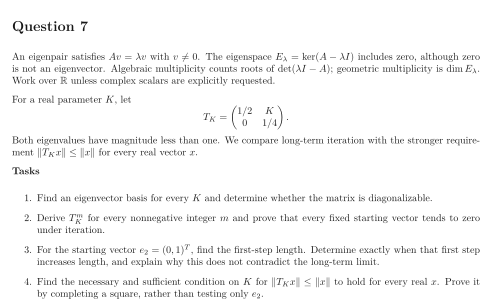
Step 3: Exhibit a transient length increase. The first image of is , of length . It exceeds exactly when . An early increase and eventual decay concern different times, so there is no contradiction. The plot uses and shows the actual lengths at integer iteration counts; the initial increase is followed by decay.
Step 4: Test all directions, not just one. For , direct expansion and completion of the square give This is nonpositive for every exactly when the last coefficient is nonpositive: necessity follows by choosing with . Hence the exact condition is This stricter threshold cannot be recovered by checking only or only the eigenvalues. At equality, nonzero vectors on retain their length in one step; outside that line they decrease.
See the diagram in the original worksheet below.