Question 1
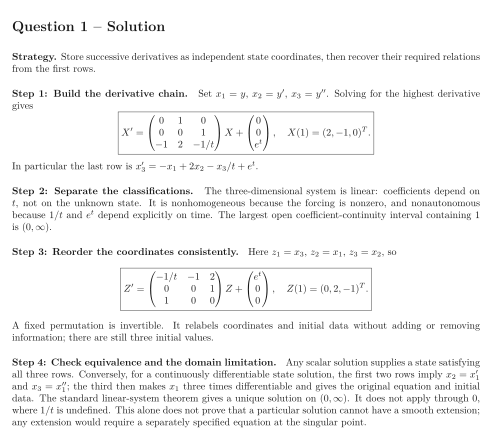
Consider the scalar initial-value problem, for , A first-order state must contain enough information to determine all of its first derivatives. A system is autonomous when its right-hand side has no explicit dependence on the independent variable.
Tasks
Use to write and the complete initial state.
Classify the system as linear or nonlinear, homogeneous or nonhomogeneous, and autonomous or nonautonomous. State its dimension and the largest coefficient-continuity interval containing .
Use instead . Find the transformed system and initial state, explaining why reordering state variables changes neither the underlying problem nor the number of initial values.
Prove equivalence in both directions between the scalar equation and your first state system. Explain what the coefficient singularity does, and does not, establish about continuation through .
Show solutionHide solution
Question 1 – Solution
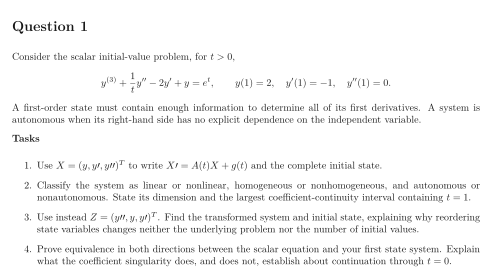
Strategy. Store successive derivatives as independent state coordinates, then recover their required relations from the first rows.
Step 1: Build the derivative chain. Set , , . Solving for the highest derivative gives In particular the last row is .
Step 2: Separate the classifications. The three-dimensional system is linear: coefficients depend on , not on the unknown state. It is nonhomogeneous because the forcing is nonzero, and nonautonomous because and depend explicitly on time. The largest open coefficient-continuity interval containing is .
Step 3: Reorder the coordinates consistently. Here , , , so A fixed permutation is invertible. It relabels coordinates and initial data without adding or removing information; there are still three initial values.
Step 4: Check equivalence and the domain limitation. Any scalar solution supplies a state satisfying all three rows. Conversely, for a continuously differentiable state solution, the first two rows imply and ; the third then makes three times differentiable and gives the original equation and initial data. The standard linear-system theorem gives a unique solution on . It does not apply through , where is undefined. This alone does not prove that a particular solution cannot have a smooth extension; any extension would require a separately specified equation at the singular point.