Question 3
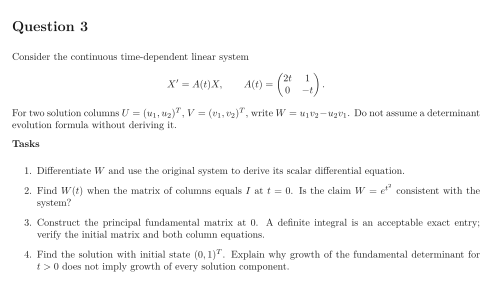
Consider the continuous time-dependent linear system For two solution columns , , write . Do not assume a determinant evolution formula without deriving it.
Tasks
Differentiate and use the original system to derive its scalar differential equation.
Find when the matrix of columns equals at . Is the claim consistent with the system?
Construct the principal fundamental matrix at . A definite integral is an acceptable exact entry; verify the initial matrix and both column equations.
Find the solution with initial state . Explain why growth of the fundamental determinant for does not imply growth of every solution component.
Show solutionHide solution
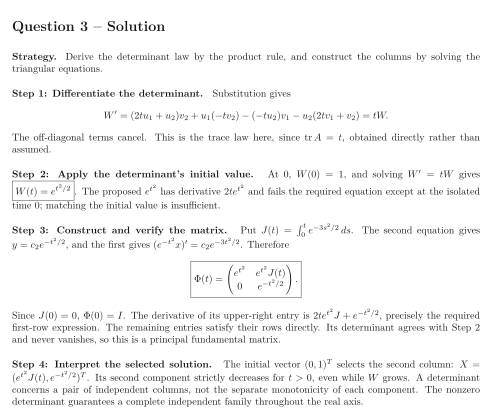
Question 3 – Solution
Strategy. Derive the determinant law by the product rule, and construct the columns by solving the triangular equations.
Step 1: Differentiate the determinant. Substitution gives The off-diagonal terms cancel. This is the trace law here, since , obtained directly rather than assumed.
Step 2: Apply the determinant’s initial value. At , , and solving gives . The proposed has derivative and fails the required equation except at the isolated time ; matching the initial value is insufficient.
Step 3: Construct and verify the matrix. Put . The second equation gives , and the first gives . Therefore Since , . The derivative of its upper-right entry is , precisely the required first-row expression. The remaining entries satisfy their rows directly. Its determinant agrees with Step 2 and never vanishes, so this is a principal fundamental matrix.
Step 4: Interpret the selected solution. The initial vector selects the second column: . Its second component strictly decreases for , even while grows. A determinant concerns a pair of independent columns, not the separate monotonicity of each component. The nonzero determinant guarantees a complete independent family throughout the real axis.