Question 5
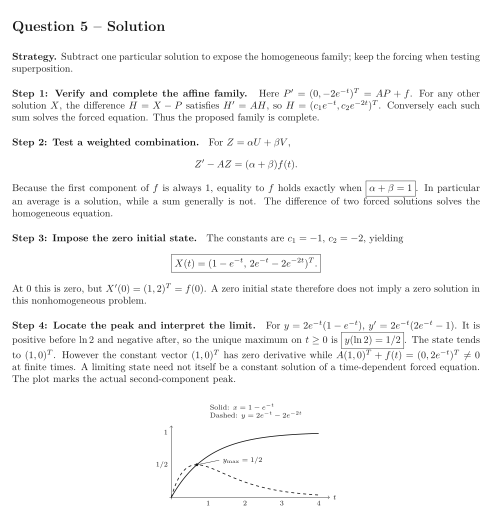
Consider The proposed particular solution is . Distinguish combinations of homogeneous solutions from combinations of solutions of this fixed nonhomogeneous system.
Tasks
Verify , and prove that the full solution family is .
If both solve the fixed forced system, determine exactly when also solves it. Prove the condition for real constants .
Solve the IVP and check its initial derivative against the original right-hand side.
For , find the maximum of the second component of this IVP and its time. Find the limiting state and decide whether that limiting vector, held constant, is itself a solution of the forced system.
Show solutionHide solution
Question 5 – Solution
Strategy. Subtract one particular solution to expose the homogeneous family; keep the forcing when testing superposition.
Step 1: Verify and complete the affine family. Here . For any other solution , the difference satisfies , so . Conversely each such sum solves the forced equation. Thus the proposed family is complete.
Step 2: Test a weighted combination. For , Because the first component of is always , equality to holds exactly when . In particular an average is a solution, while a sum generally is not. The difference of two forced solutions solves the homogeneous equation.
Step 3: Impose the zero initial state. The constants are , , yielding At this is zero, but . A zero initial state therefore does not imply a zero solution in this nonhomogeneous problem.
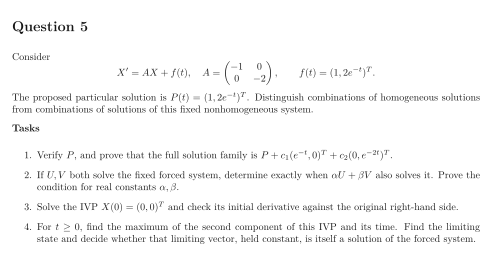
Step 4: Locate the peak and interpret the limit. For , . It is positive before and negative after, so the unique maximum on is . The state tends to . However the constant vector has zero derivative while at finite times. A limiting state need not itself be a constant solution of a time-dependent forced equation. The plot marks the actual second-component peak.
See the diagram in the original worksheet below.