Question 9
For only the measurements and are given, where . The second initial component is unknown. You may verify solutions using sine and cosine identities; no phase-plane analysis is required.
Tasks
Find every solution consistent with , using one arbitrary constant, and identify what that constant means.
Classify existence and uniqueness for all and , including the exceptional times .
Apply the classification to and . Give the full solution set in each case.
When , suppose the reported value of has an error . Find the exact resulting error in the recovered second initial component. Explain what happens as and why this is not failure of uniqueness for a fully specified IVP.
Show solutionHide solution
Question 9 – Solution
Strategy. Treat the unknown initial velocity as a parameter and ask whether the observations actually determine it.
Step 1: Parametrize all compatible initial states. Since and , the complete family is Direct differentiation verifies both rows. The arbitrary constant is , the missing initial component.
Step 2: Test the observation equation. The second measurement requires . If , there is exactly one solution, with . If for a positive integer , the measurement is independent of : there are infinitely many solutions when , and none when . These cases exhaust all positive times.
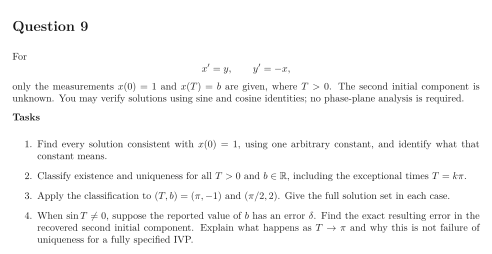
Step 3: Evaluate the two specified experiments. At every real is allowed, giving the full family in Step 1. The figure shows three of these indistinguishable endpoint measurements. At , , so the unique solution is
Step 4: Quantify sensitivity and interpret it. Replacing by changes by exactly . Thus the absolute amplification factor is , which is unbounded as through nonexceptional times. A fixed nonzero measurement error can then create a large recovered initial-velocity error. At , that component is unobservable from these two measurements. Each fully specified initial vector still has a unique solution; the difficulty lies in recovering it from partial observations.
See the diagram in the original worksheet below.