Question 2
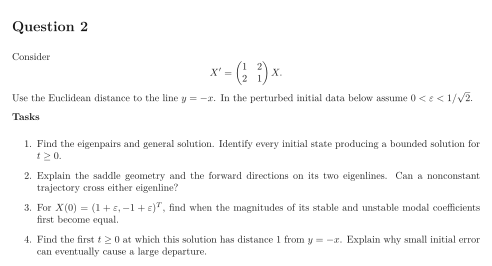
Consider Use the Euclidean distance to the line . In the perturbed initial data below assume .
Tasks
Find the eigenpairs and general solution. Identify every initial state producing a bounded solution for .
Explain the saddle geometry and the forward directions on its two eigenlines. Can a nonconstant trajectory cross either eigenline?
For , find when the magnitudes of its stable and unstable modal coefficients first become equal.
Find the first at which this solution has distance from . Explain why small initial error can eventually cause a large departure.
Show solutionHide solution
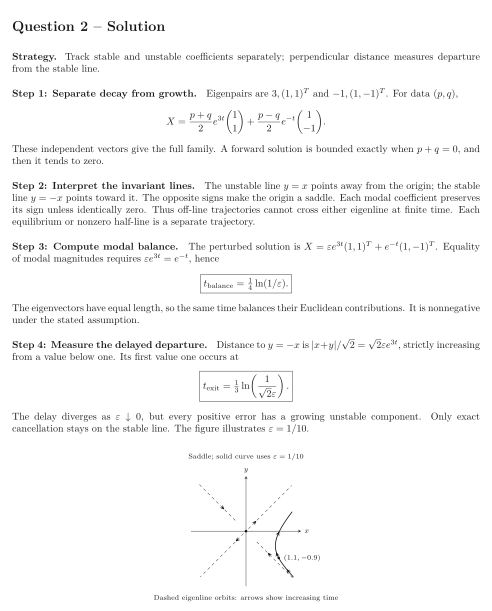
Question 2 – Solution
Strategy. Track stable and unstable coefficients separately; perpendicular distance measures departure from the stable line.
Step 1: Separate decay from growth. Eigenpairs are and . For data , These independent vectors give the full family. A forward solution is bounded exactly when , and then it tends to zero.
Step 2: Interpret the invariant lines. The unstable line points away from the origin; the stable line points toward it. The opposite signs make the origin a saddle. Each modal coefficient preserves its sign unless identically zero. Thus off-line trajectories cannot cross either eigenline at finite time. Each equilibrium or nonzero half-line is a separate trajectory.
Step 3: Compute modal balance. The perturbed solution is . Equality of modal magnitudes requires , hence The eigenvectors have equal length, so the same time balances their Euclidean contributions. It is nonnegative under the stated assumption.
Step 4: Measure the delayed departure. Distance to is , strictly increasing from a value below one. Its first value one occurs at The delay diverges as , but every positive error has a growing unstable component. Only exact cancellation stays on the stable line. The figure illustrates .
See the diagram in the original worksheet below.