Question 10
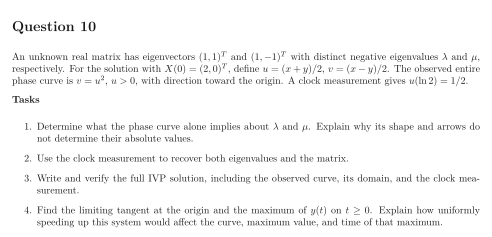
An unknown real matrix has eigenvectors and with distinct negative eigenvalues and , respectively. For the solution with , define , . The observed entire phase curve is , , with direction toward the origin. A clock measurement gives .
Tasks
Determine what the phase curve alone implies about and . Explain why its shape and arrows do not determine their absolute values.
Use the clock measurement to recover both eigenvalues and the matrix.
Write and verify the full IVP solution, including the observed curve, its domain, and the clock measurement.
Find the limiting tangent at the origin and the maximum of on . Explain how uniformly speeding up this system would affect the curve, maximum value, and time of that maximum.
Show solutionHide solution
Question 10 – Solution
Strategy. Geometry determines a ratio of modal rates; one elapsed-time observation fixes their common scale.
Step 1: Extract a rate ratio. Initially , so and . The identity for every time implies . Any with this ratio gives the same oriented orbit as ranges over the real line. Thus the curve and its arrows alone leave one positive speed factor undetermined.
Step 2: Calibrate the clock. The measurement yields , so and . Using the specified eigenbasis reconstructs
Step 3: Verify the reconstructed trajectory. The solution is Differentiating and multiplying by the displayed matrix agree component by component, and the initial state is . Moreover , , and . Every occurs at a finite real time; the limiting origin is excluded from the orbit.
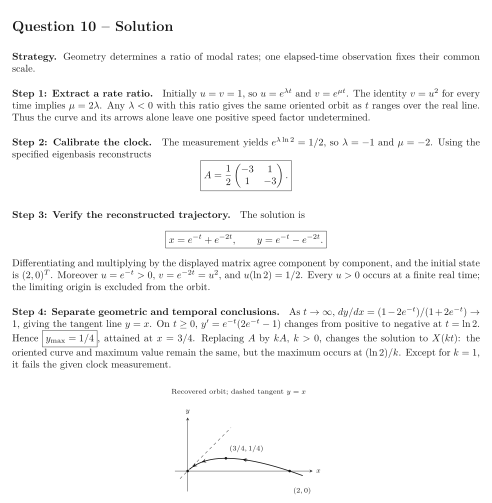
Step 4: Separate geometric and temporal conclusions. As , , giving the tangent line . On , changes from positive to negative at . Hence , attained at . Replacing by , , changes the solution to : the oriented curve and maximum value remain the same, but the maximum occurs at . Except for , it fails the given clock measurement.
See the diagram in the original worksheet below.