Question 1
Let Use a complex eigenvector to construct real solutions. Angles in the original plane are measured counterclockwise from the positive -axis.
Tasks
Find the eigenvalues and an eigenvector for the eigenvalue with positive imaginary part. Separate its exponential solution into real and imaginary parts.
Prove that the resulting two real solutions are independent and solve the IVP.
Find the radius, an unwrapped angle, and the first positive time at which this trajectory reaches the positive -axis.
Find the radius multiplier after one full revolution. Is the nonzero solution periodic? Explain why the conjugate eigenpair does not supply two additional independent real solutions.
Show solutionHide solution
Question 1 – Solution
Strategy. Take real and imaginary parts with their signs intact, then use polar coordinates to separate decay from rotation.
Step 1: Extract real solutions. The eigenvalues are . For , choose , which satisfies . Writing gives Because is real, both parts solve the original real system.
Step 2: Resolve the initial state. The determinant of the columns is . At zero they are and , so : The nonzero determinant and linear-system uniqueness give the complete real family as arbitrary real combinations of .
Step 3: Locate the first positive-axis crossing. Let , which lies in . Here and a continuous angle is . Rotation is counterclockwise. The first positive time on the positive -axis requires , hence . The earlier negative-axis crossing is not the requested event.
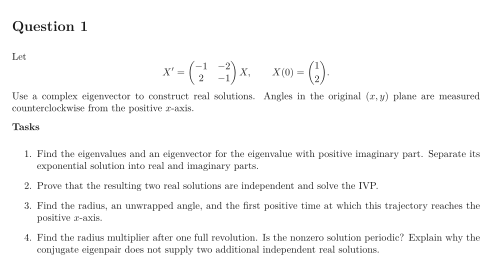
Step 4: Separate revolution from repetition. One revolution takes , reducing the radius by . Since the radius strictly decreases, no nonzero solution is periodic; the origin is a stable spiral. Conjugating the exponential solution gives , whose parts are , already in the same real span. Thus a conjugate pair supplies two real degrees of freedom, not four. The figure shows a finite forward segment of the stated IVP.
See the diagram in the original worksheet below.